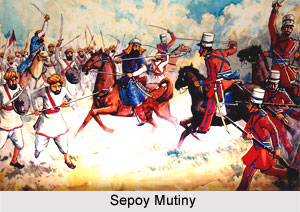
 After triumphantly reconquering the entire nation from the rebellious soldiers, it was now time to reconquer Western India. In this endeavour, British soldiers left no stones unturned to accomplish success as fast as was possible. Western India comprised an enormous land area, impregnated with huge forest tracks, making the task rather tough for British to baffle the natives. Final results of the 1857 uprising were still awaiting its turn.
In Haidarabad (Hyderabad, Andhra Pradesh), throughout the Sepoy Mutiny of 1857, the loyalty of the Nizam and of his able minister, Salar Jung, had been the surest guarantees of peace. In the early days of July 1857, the turbulence of the foreign troops in the service of the Nizam had caused an attack upon the Residency. But the gifted representative of British authority in that territory, Major Cuthbert Davidson, warned by Salar Jung, had time to make preparations. This terminated not only in the embarrassment of the rebels, but also in the capture and punishment of the leaders. One of the cavalry regiments at Aurangabad had already been disarmed. But the aberration of the mutineers was transitory.
The men returned to their duty and rendered, with their comrades in the contingent of the three arms, excellent service to the State. A little later, the Raja of Shorapur, a Hindu assistant of the Nizam, broke out into treacherous revolt. But Major Davidson, acting in unison with Lord Elphinstone, called up from the Southern Maratha country the armed forces serving under Colonel Malcolm. The Governor of Madras, Lord Harris, despatched to the spot a force under Major Hughes. The troops of the Haidarabad (Hyderabad) contingent, under Captain Wyndham, proceeded likewise to aid in the coercion of the deluded prince. The latter, after a vain attempt to lure Wyndham to his destruction, surrendered himself as a prisoner. The Raja`s mind was tremendously affected, for he committed suicide when it was announced to him that, after four years of detention, he would be allowed to resume his position.
Meanwhile, Sir Hope Grant, under orders from Sir Colin Campbell, had proceeded in carrying out his plan for the pacification of Oudh. He was placed near Lakhnao (Lucknow), on the 16th of May. From that date to the end of August he continued his operations. Grant beat the rebels in every encounter and finally halted at Sultanpur. There he thought it wise to suspend operations till the close of the rainy season. He resumed them in the middle of October.
Meanwhile, there had been some fighting in Rohilkhand. At Philibhit, it became known that the rebels were concentrated in force at Nuriah. From there, they were dislodged by a force commanded by Captain Sam Browne, under circumstances of great gallantry. In the turbulent district of Azamgarh, too, the rebels had again raised their heads. They were, however, cleared from the district by a force under Brigadier Berkeley. Berkeley recovered Eastern Oudh as far as Sultanpur, where he touched Hope Grant`s force.
On the other hand Rowcroft with a combined force of his own troops and the sailors of the Pearl brigade had defeated the rebels at Amorha and Harha. Eveleigh had punished the rebels from Husenganj and Mohan. Dawson had captured Sandela. With such feats in their kitty the British forces rested during two months of the rainy season. However, that period was employed by sending Sikhs in steamers up the Ganga River to clear its banks.
Operations to thrash the uprising were resumed in October. The rebels began by attacking Sandela. They were held in check by Dawson. Major Maynard, then Brigadier Barker, arrived and inflicted upon them a crushing defeat. In the same month, Eveleigh defeated them at Mianganj and Seaton near Shahjahanpur. The Raja of Powain rebuffed an attack made upon his fortified town. Sir Colin Campbell, now Lord Clyde, then resolved to clear the entire province of rebels by acting in columns in all its districts simultaneously. One column, drawn from Rohilkhand, was ordered to clear the north-west of Oudh. Sweeping all before it, the column should establish itself at Sitapur. Four columns were ordered to clear the Baiswara country. Another troop was ordered to guard the Duab and the other the Kanhpur (Kanpur) road. Smaller troops from Lakhnao (Lucknow), Nawabganj, Daryabad and Faizabad were commanded to clear the districts around them.
This plan was acted upon with complete success. On the 3rd of November, Wetherall, marching to join Hope Grant, stormed Rampur Kasia. Hope Grant, joining him there, moved against Amethi on one side, while Lord Clyde attacked it on another. The place surrendered on the 8th. The strong fort of Shankarpur was evacuated by Beni Madhu, a noted rebel, on the night of 10th November and occupied the next day. Eveleigh, following Beni Madhu, caught him two days later at Dundia Khera and defeated him, taking three of his guns. On the 24th, that rebel was again encountered, this time by Lord Clyde and completely defeated.
In the interim, the strong places in Eastern Oudh had fallen in succession. By the end of November that part of the province was completely subdued. The troops sweeping the north-western districts had been equally successful. Troup had cleared the ground till Sitapur. Gordon, Carmichael and Horsford had followed suit in the districts south of the Gogra. Hope Grant, catching the rebels beaten by Rowcroft at Tulsipur, had swept them into Nepal.
On the other hand Lord Clyde, moving towards Sikrora, was in touch with Grant on the one side and Rowcroft covering Gorakhpur on the other. He drove the Begum and Nana Sahib before him from Bondi and Bahraitch. Clyde was successful to clear the country between Nanpara and Gogra. Then marching towards Banki, close to the Nepal frontier, he surprised and defeated the rebels and swept the survivors into Nepal. Jang Bahadur, loyal to the core, informed the rebels who crossed that they must not look to him for protection. He even permitted British troops to come over and disarm any considerable body of rebels who might have sought refuge there.
After the conciliation of Oudh Lord Clyde quitted the province, leaving it to Hope Grant to carry out such operations as might be necessary. What little remained to be executed was then done thoroughly. Colonel Walker crushed at Bangaon, the more hardened rebels, the survivors of the regiments which had perpetrated the Kanpur Unrest massacre. Grant himself pursued the terrified remnant across the hills into Nepal. Dislodgment alone was necessary, for they had neither arms, nor money, nor food. Satisfying himself with locating troops to prevent their return, Grant reported (May 1859) that Oudh was at peace at last.
The conciliation of Oudh was the closing act of the drama, the curtain of which had been raised in 1857. In the interval, Sir John Lawrence had, with characteristic energy, put down an attempted rising in the Gughaira district, turbulent even in the time of Akbar. His brother, George Lawrence, had dispersed the few malcontents in Rajputana. The rebels had been crushed, though after a tedious and desultory warfare, in the Chota Nagpur districts. Western Bihar had been pacified by the dispersion of the last adherents of the family of Kunwar Singh. When Sir Hope Grant finally cleared Oudh of the last remnants of the rebels, in May 1859, then it could be said that the Sepoy Mutiny had been absolutely stamped out.