 Central India was a late-boiling instance in the Sepoy Mutiny of 1857. As the Britons were gradually wrapping up their tasks in the various other places in the country, these portions rose in fury. The reconquest of Central India became absolutely necessary for the British. The administrative power of these areas was entrusted in the competent hands of Lord Elphinstone. He was a remarkable man to make the common man reside in peace with the rulers.
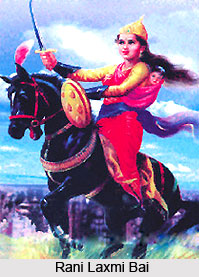
After entrusting several officers in the task of consolidating the central parts of the country, it was time for Sir Hugh Rose to take the royal chair. He arrived in Indore on 17th of Decemder to assume the post. Amassing several troops under Brigadier Stuart, they started out in their mission to reconquer. Destroying numerous native rebel forces on the way, Sir Hugh reached Jhansi on 21st of March. There they had to face the overwhelming presence of the fort, accompanied by the intimidating force of Rani of Jhansi. However, Tantya Topi had also united with the Rani`s tremendous force.
Since his defeat by Sir Colin Campbell at Kanhpur (Kanpur), in the preceding December, Tantia Topi had fallen back on Kalpi. He had emerged from there some time in February, with 900 followers, to besiege Charkhari and had captured it. Topi`s force increased by the junction of five or six regiments of the Gwaliar (Gwalior) contingent and some local levies to 22,000 men and twenty-eight guns. This force was now responding to a request sent him by the Rani of Jhansi to march to her relief.
The situation in which the advance of Tantia placed Sir Hugh Rose was quite critical. However, the bold and resolute leader was especially qualified to grapple in such situations. Realising that to interrupt the siege operations would give the rebels a confidence sufficient to impel them, he resolved still to press the siege. With the troops not on actual duty, amounting to 1500 men, of whom only one-third were Europeans, Sir Hugh marched to intercept Tantya Topi. At four o`clock the following morning (April 1) Tantya advanced towards the point where the 1500 men of Sir Hugh`s force lay ready for action. When the rebels came within striking distance, Sir Hugh opened fire. Then, simultaneously attacking their right and left, doubled both up at the centre, he then sent his infantry to attack it.
These three blows, delivered with the most perfect precision so surprised the rebels that their first line broke and fled. There still remained the second line, covered by a belt of jungle and led by Tantya in person. Recognising his danger, and anxious to save his second line and guns, Tantya fired the jungle and pulled back. The men with him were the men of the Gwaliar (Gwalior) contingent. So orderly and well-conducted was their retreat that they succeeded in carrying their guns and some of the fugitives of the first line across the Betwa River. But the British cavalry, and horse-artillery, splendidly led, were not to be bemused. Dashing at a gallop through the burning jungle, they followed Tantya for several miles. Nor did they cease until they had captured every one of his twenty-eight guns.
The garrison at Jhansi was disappointed by the failure of Tantya Topi to relieve them. Sir Hugh resolved to take advantage of their depression to storm at the earliest possible date. This was the second day after his victory over Tantya. At three o`clock in the morning of the 3rd of April, the stormers marched on the positions assigned to them. The left attack was divided into two columns. The right was led by Colonel Lowth and Major Stuart, both of the 86th. They succeeded, after a desperate fight, in storming the wall and seizing the positions assigned to them. The right attack, the left column of which was led by Colonel Liddell and Captain Robinson, had tremendous difficulties to overcome.
The rampart they had to escalade was very high, and their scaling ladders were too short. However, by the splendid gallantry of three officers of the engineers, Dick, Meiklejohn, and Bonus, and of Fox of the Madras Sappers, they succeeded in gaining a footing there. Just then Brockman, from the left attack, made a timely charge on the flank and rear of the defenders. Their determination immediately diminished and the right attack made good its hold. The stormers now marched to the palace, gained it after a stubborn resistance and drove the rebels helter-skelter from the town. There they were assailed by the 24th Bombay N. I. and dispersed. But indiscriminate combating continued all night. Rani Laxmi Bai took advantage of the darkness and disorder to ride with a small following for Kalpi, where she arrived safely. Early the next morning, Sir Hugh occupied Jhansi. Its capture had cost him 343 killed and wounded, of whom thirty-six were officers. The rebels` loss he put down roughly at 5000.
Leaving a small but sufficient garrison in Jhansi, Sir Hugh marched on the 25th of April for Kalpi. Kalpi was a place from where throughout the Mutiny the rebels had sallied to harass and destroy. On the 5th of May he stormed Kunch, defeating the rebels in its vicinity. But, owing to the heat of the day, he could not prevent their seizing the Kalpi road and marching along it. He sent, however, his cavalry in pursuit. The cavalry, gallantly led by Prettijohn of the 14th Light Dragoons, pursued the enemy for miles. Pushing on, Sir Hugh established himself at Gulauli, near Kalpi, on the 15th.
Sir Hugh had been strengthened, on 5th of May, by the addition of the 71st Highlanders. At Gulauli he came in touch with Colonel G. V. Maxwell, commanding a column composed of the 88th, the Camel Corps, and some Sikhs, on the left bank of the Jamnah (present day Yamuna River). The rebels, too, had been considerably strengthened. Their position at Kalpi was very formidable, intersected by labyrinths of ravines, impossible for artillery and cavalry to breach through. As a result, their confidence had returned. The natural advantages of their position the natives had improved by throwing up entrenchments at all the salient points.
Sir Hugh spent the five days following his arrival at Gulauli in establishing his batteries, in effecting a junction with Maxwell and in constant skirmishes with the rebels. On the 21st of May, his batteries opened fire and on the 22nd he delivered his attack. The battle that ensued was one of the fiercest and most hotly contested of that terrible war. At one phase of it the rebels, strongest on the decisive point, gained an actual advantage. The rebels, enlivened by a confidence they had never felt before, pressed on with loud yells. The British fell back towards the field-guns and the mortar battery. Then, Brigadier C. S. Stuart, dismounting, placed himself by the guns and bade the gunners defend them with their lives. Just at the moment, when the British were almost exhausted, 150 men of the Camel Corps came up and turned the tide.
At the moment the rebels had advanced within twenty yards of the battery and of the outpost tents. The men from the outpost were entirely struck down by the sun. If another quarter of an hour had passed, there would have been a massacre. But the timely arrival of the Camel Corps saved the day and converted defeat into victory. It enabled Sir Hugh Rose to close with glory the first part of his dashing Central Indian campaign.
The defeat he inflicted on the rebels was critical. They dispersed in all directions, broken and demoralised. In five months Sir Hugh had, under many difficulties, traversed Central India, crossed deep rivers, stormed strong fortresses, defeated the rebels in the field, and re-established British authority in an important region of India. It was impossible to have done this better than Sir Hugh Rose did it. As a campaign it was faultless.