


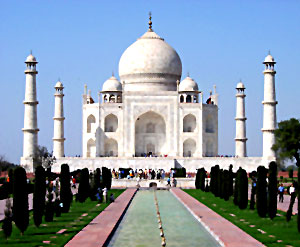
 The history of Taj Mahal will definitely take one back to the Mughal eras of Akbar and his father Humayun. The Mughal invasion of India was nothing but an explosion of anger and conquest - a great demonstration of the powerful human instinct and aggressive urge to explore and conquer. With drawn swords and shrill battle cries, they came from harsh, dry, desert lands. Some of those who came and destroyed the land's cultural heritage but some were peace-loving rulers. Akbar was one of them. His policies of religious tolerance made him popular with the masses. His son, Jahangir, was a connoisseur and patron of the arts and crafts. It was in such milieu that Prince Khurram, later known as Shah Jahan, was born. The history of Taj Mahal will definitely take one back to the Mughal eras of Akbar and his father Humayun. The Mughal invasion of India was nothing but an explosion of anger and conquest - a great demonstration of the powerful human instinct and aggressive urge to explore and conquer. With drawn swords and shrill battle cries, they came from harsh, dry, desert lands. Some of those who came and destroyed the land's cultural heritage but some were peace-loving rulers. Akbar was one of them. His policies of religious tolerance made him popular with the masses. His son, Jahangir, was a connoisseur and patron of the arts and crafts. It was in such milieu that Prince Khurram, later known as Shah Jahan, was born.
It was in the festive Meena Bazaar of Agra that Prince Khurram met the14-year old Arjamand Bano selling glass beads with long tresses, deep expressive eyes and a delicate aquiline nose. Undoubtedly she was beautiful. Prince Khurram fell in love with her then and there. In fact it would not be wrong to say that the young prince was magnetically drawn to her. That timeless moment moulded their future together for posterity. She held a piece of glass in her hand and told the young prince it was a rare and precious diamond. She even succeeded in selling it for an unbelievable amount. When Prince Khurram expressed his desire to marry Arjamand Bano the very next day after he met her, Jahangir immediately consented. However, that marriage was not to happen until five years later. Meanwhile, Shah Jahan's first marriage was arranged with Quandari Begum, a princess from the Persian royal family. Despite this his feelings towards Arjamand Bano had not changed. He loved her just as deeply and as madly as that memorable moment when they had first met. 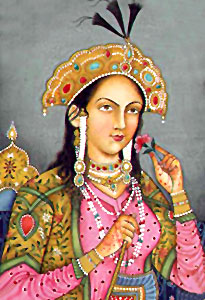 In 1612, the young prince was finally permitted to marry Arjamand Bano. She was given the name Mumtaz Mahal or 'the chosen one of the palace'. In 1616 Prince Khurram who emerged victorious from the battle of Deccan, was bestowed the title of Shah Sultan Khurram. On 29th October 1627 Jehangir passed away. The 4th February of 1628, saw Shah Sultan Khurram became Shah Jahan, Emperor of the World.
For 19 long years, Mumtaz Mahal had been his constant companion accompanying him everywhere; from the prayer halls to pleasure gardens to river banks and court meetings, to the coronation and finally to the battlefields. She was his playmate, companion, confidante, friend, philosopher and guide. The two shared such a deep bond of affection, attachment and understanding; that they were nearly inseparable from one another. Mumtaz-uz-Zamani died in 1631 on the battlefields of Burhanpur. She had accompanied her husband despite his severe remonstrations not to do so. As Mumtaz Mahal lay on her deathbed she asked Shah Jahan to fulfill few promises. Amongst these one was to build a monument that would symbolize the beauty, purity and the depth of their love. That the emperor's heart was heavy with grief is a mild way to express how her passing away so prematurely had shattered his world. The young man so fond of opulence then confined himself to a life enshrined in mere memories. Almost overnight his luxurious lifestyle underwent a complete change. Pomp and splendour now gave way to austerity. For two years the entire state observed deep mourning. The emperor had turned 'fakir' at heart. He desired nothing. His days were pale, colourless, devoid of life as it were. Dressed in white, a Spartan way of life became a habit. The pain of separation gripped him. With an iron will, perhaps a legacy of the Rajput blood flowing in his veins, he steeled himself to create an outstanding work of art. 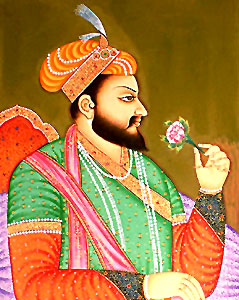 The painstaking detail with which more than 20, 000 of the world's finest craftsmen toiled for 17 long years, (between 1632 to 1648) makes the Taj a great vision of an intense emotion captured frame-by-frame in exquisite marble. The planning team and the builders of the Taj Mahal were practitioners of a sacred science, flawless geometry and religious architecture. They comprised of a mix of Indian, Persian and Turkish experts. This monument was a form of secular art that was neither Saracenic, Central Asian nor Hindu or Islamic in expression. Rather it was divine in its purity.
In the Badshahnama by Abdul Hamid Lahori the official chronicler to Emperor Shah Jahan, it is mentioned that the building was constructed at a cost of Rs. 50 lakhs. In earlier times, two silver doors stood majestically at the entrance of the Taj Mahal. They were believed to have been made at a cost of Rs 1, 27,000. Each door was studded with 1,100 nails each having a head made of a rupee coin. A feature that is common to many schools of religious architecture is symmetry and self-replicating patterns. Like a fractal pattern, the symmetry keeps appearing even in the minutest block of the monuments that adorn the Taj Mahal building complex. And thus the ethereal monument, Taj Mahal, was built. Once the Taj Mahal is seen, it will stay on forever in one's mind, rejuvenating the inherent romantic self. Like a weaver, forging new threads and darning old ones, the Taj Mahal remains as a beautiful tapestry in one's memory. Doubtlessly, there's something mesmerizing about the Taj Mahal. The monument spells out a warning. Love and romance can happen to anyone, anywhere, anytime. |
| |||



Home > Art & Culture > Indian Monuments > World Heritage Monuments in India > World Heritage Monuments in North India > Taj Mahal in Agra > History of Taj Mahal
History of Taj Mahal
| The history of Taj Mahal whispers the saga of a royal love. |
| ||||||||||||||||||||||||||||

