 The effects of reconquest of Central India were consolidated the position of the East India Company but it did have its repercussions as well. British forces had already suffered huge losses both in lives and ammunition during the siege of Central India. Sir Hugh Rose had greatly distinguished himself in his presence of mind and placing of armed troops in several salient points. A lot of issues were yet to be addressed.
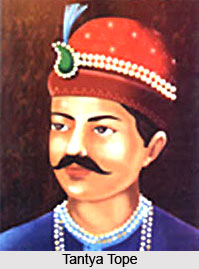
One of them was Tantya Tope. He was posing a problem by eluding every move of the British to capture him. The rebels, who were in a state of continuous flight, had rejoined hands with native forces to build up a strong guard. Although English rulers had been victorious in reconquering the other places, Central India was still awaiting its after-effects. The bold Whitlock was slowly advancing in his path to take on rebellious effects under the guidance of Sir Hugh.
The army under Whitlock had moved, on the 17th of February, from Jabalpur towards Bundelkhand. On the 19th of April, he appeared before Bandah and defeated the troops which the Nawab of that place had collected. From Bandah, Whitlock intended to march to Kalpi. But on his way there, he received instructions to turn from his course and march against Kirwi. The Rao of Kirwi, an irresponsible minor, a ward of the British, was charged with rebellion. Whitlock then occupied Kirwi without much resistance from the opposition and declared all the enormous treasures it contained to be spoils of the victors. In this contention, he was supported by the Government of India. The spoil was subsequently divided.
Sir Hugh Rose, after his five months campaign in the reconquest of Central India, had the right to hope that he might be allowed some rest. In view of this, he had applied for leave on medical certificate, accompanying his application with the formal resignation of his command. But, on the 1st of June, there occurred, close to Gwaliar (Gwalior), an event which upset all his calculations. The news of it reached him on the 4th. It was to the effect that Tantya Tope and the Rani of Jhansi, recollecting their scattered followers, had marched towards Morar. Sindhia, marching to meet Tantya at the head of 6000 infantry, 1500 cavalry and his own bodyguard, 600 strong, had had the humiliation to be deserted by his troops. He had fled, without drawing rein, to Agra.
Sir Hugh had previously despatched a party, under Colonel Robertson, on the track of the rebels he had defeated at Kalpi. On the 1st, that officer had notified to him that Tantya and his followers had taken the road to Gwaliar (Gwalior). Sir Hugh had at once sent forward the remainder of Brigadier Stuart`s brigade. On the 5th of June, he started himself, with a small force, to overtake Stuart.
Sir Hugh overtook Stuart at Indurki on the 12th of June and reached Bahadurpur, five miles to the east of Morar, on the 16th. There he was joined by General Robert Napier and by a portion of the Haidarabad (Hyderabad) contingent. The following morning he attacked and completely defeated the rebels posted at Morar. General Smith`s brigade of the Rajputana field force, which had been ordered to proceed to Gwaliar (Gwalior), attacked them the following morning on the hilly ground between Kotah-ki-sarai and Gwaliar. After a severe contest, the Rajputana force pushed the rebels to retreat.
In this action, the legendary Rani of Jhansi was slain, fighting daringly to the last. The rebels, however, though beaten, were still numerous. The position taken up by Smith for the night left him exposed to the attack of their united force. Sir Hugh then resolved to finish with them. Accordingly, leaving Napier, with one army post at Morar, Sir Hugh, on the 18th of June, opened communications with Smith.
Cutting off the rebels from Gwaliar (Gwalior), Sir Hugh sent Stuart on the 19th of June, to attack their left. Meanwhile, Raines was to amuse the rebel forces on the right. The action which followed was successful. In it Brockman of the 86th greatly distinguished himself. One consequence of it was the capture of the city of Gwaliar (Gwalior) the same evening. The fort of Jhansi, however, still defied the victors. An extraordinary act of daring was performed on the part of two British officers, Rose and Waller to capture it. These two officers, with a small following, overwhelmed the apparently impregnable place. The fortress fell into their hands in the dawn of the 20th of June.
On the 19th of June Sir Hugh had recognised that his attack on the rebels was gaining success. He thus sent a despatch to Napier to pursue and follow them up as far and as closely as was possible. Napier set out on the morning of the 20th and the following morning came up with the enemy, approximately 12,000 strong. They were posted at the village of Jaura-Alipur. He at once attacked and defeated them, taking from them twenty-five guns and all their ammunition, tents, carts, and baggage. This victory was, for the time, their death-blow. Apparently it finished the campaign.
His work accomplished by the restoration of Sindhia, Sir Hugh Rose resigned his command. He proceeded to Bombay, to assume there the office of Commander-in-Chief of the Bombay Presidency. He was replaced in command of the Central India force by Robert Napier. This officer was soon to find that the security which had seemingly followed the victory of Jaura-Alipur, was but temporary.
Tantya Tope, escaping from the field in Gwalior, had fled in a north-westerly direction. Finding, however, that his escape would be difficult, he had turned and made for Jaipur. There were ranged round the area and in the vicinity of Gwaliar itself, in which Tantya would be likely to move Napier`s force at, a smaller force at Jhansi. Another force was posted at Sipri, a fourth at Gunah, a fifth at Nasirabad and a sixth at Bharatpur. There were other forces round the outer ring of this girdle. It seemed, therefore, that the chances of escape for Tantya were slim indeed.
Yet so extraordinary was the vitality of this remarkable man that for more than nine months he kept all the troops and many others, in a state of continual movement against him. On the 28th of June, 1858, Tantya Tope and his small following were mystified by Brigadier Roberts in his attempt to gain Jaipur. Two days later Holmes foiled him in an attempted raid on Tonk. On the 7th of August, Roberts caught and defeated Tantya near Sanganer. This action was a type of all the actions fought by Tantya. It was his habit to occupy a strong position covered by skirmishers. These skirmishers held the position long enough to ensure the retreat of the main body. On this occasion Tantya escaped, fought Roberts again on the 14th of August, on the Bands and again escaped. As he fled towards the Chambal River, the pursuit was taken up by Parkes, who, however, was misled by false information. Tantia then moved towards Jhalra-Patan and took possession of it.
Recruiting there a heavy contribution, Tantya Tope made as though he would march to Indore. But, finding two British forces at Nalkerah, he moved towards Rajgarh. From there, on the approach of Michel, who had succeeded Roberts, he fled into the jungles. Tantya was followed, caught and defeated by Michel. But he fled again and for a moment disappeared from view.
Napier, meanwhile, had troubles of his own to contend with. Man Singh, Raja of Narwar, had rebelled against Sindhia and Napier had despatched Smith to coerce him. Smith not being strong enough, Napier had followed and compelled the evacuation of Narwar. Napier had despatched Robertson in pursuit of the rebels. On the Parbati River Robertson had caught and defeated a division of them, commanded by Ajit Singh on 4th September. He had then returned to Gunah. In the meantime some of the fugitives succeeded to join Tantya.
Tantya Tope, after a rest of eight days at Sironj, had marched against Isagarh. He had taken from there the supplies he wanted and had attempted the strong place of Chanderi. The Maratha chief, who held the fortress for Sindhia, was deaf alike to his promises and his threats. So Tantia made for Migrauli. There he was encountered by Michel. He was completely defeated and lost his guns. Then he fled to join Rao Sahib, nephew of Nana Sahib, at Lalitpur. The two chiefs met only to separate. Rao Sahib was caught son and beaten by Michel. The two chiefs met once again and resolved to cross the Narbada (Narmada River). They conducted this operation with great skill. Though Tantya`s right wing was annihilated by Michel at Kurai, he escaped across the river and caused an alarm which spread even to Bombay.
There, pursued by a column under Sutherland, Tantya crossed and re-crossed the river. He was caught and attacked at Kargun, only to escape with the loss of the guns, with which he had been mysteriously re-supplied. He then took the bold step of marching towards Barodah (Vadodara, Gujarat) and arrived within fifty miles of it. Finding the pursuit too hot, he turned, recrossed the Narbada (Narmada River) and reached Chota Udaipur, Rajasthan. There, Parkes caught and defeated Tantya Topi. Tantya then fled to the Banswara jungles. There his position was desperate for the cordon around him was complete. But, bold as he was able, he broke out to march for Udaipur. Finding Rocke with a force in the way, he returned to the jungles. Suddenly, emerging from there, he bemused Rocke and took his way toward Mandesar. Caught at Zirapur, Tantya fled once again. He was pursued there by Somerset and beaten. Finally, Tantya met the rebel chief Man Singh and another famous rebel, Prince Firsuzhah.
Man Singh did not stay with Tantya though. As a result he was completely surrounded now and the situation again seemed hopeless. Attempting to sneak out in a northwesterly direction, he was surprised by Showers at Dewasa, and again (January 21) by Holmes at Sikar. The surprise was so sudden that the rebel force broke up. Tantya was extremely tired of running away. He thus took refuge with Man Singh in the Paron jungles. There an attempt was made by the British authorities to persuade Man Singh to make his submission.
The trick worked. Man Singh not only submitted, but was also induced by hopes of personal advantage by giving away the hiding-place of his old comrade. At midnight, on the 7th of April, Tantya was surprised there as he slept. He was taken to Sipri and brought to a court-martial. He was charged with having waged war against the British Government, condemned and sentenced to be hanged. The sentence was carried out on the 18th of April. Tantya Tope`s capture and the surrender of Man Singh put an end to the rebellion in Central India.