Yellammpalli Project, Andhra Pradesh - Informative & researched article on Yellammpalli Project, Andhra Pradesh
  Indianetzone: Largest Free Encyclopedia of India with thousand of articles Geography of India


in  
Art & Culture | Entertainment | Health | Reference | Sports | Society | Travel
Forum  | Free E-magazine
Geography of India : Indian Climate l Indian Mountains l Indian Forests l Indian Soil l Indian Vegetation l Animal Husbandry in India l Resources in India l Indian Demography l Indian Natural History l Indian Astronomy l Indian Industries l Indian Islands l Indian Airports l Zoos in India l Indian Mines and Minerals l Indian Physiography l Indian Transport l Indian Geology l Communication in India l Indian Trade l Indian Astronomers l Indian Telecommunications
Home > Reference > Geography of India > Resources in India > Water Resources in India > Dams in India > Dams in Andhra Pradesh > Yellammpalli Project
Yellammpalli Project, Andhra Pradesh
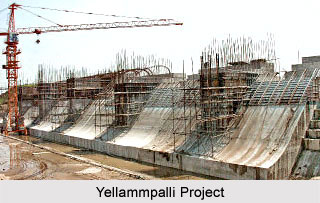
Yellampalli project or the Sripada Sagar project stands on Godavari River in Karimnagar district of Andhra Pradesh.

The ambitious Yellampalli project stands on the Godavari at Yellampalli village in Ramagundam mandal of Karimnagar district in Andhra Pradesh. Also called the Sripada Sagar project, the Yellampalli project is constructed at a height of 148 metres to store 20 tmcft of water. The project was designed by the State Government at a height of 143.5 metres and store only 9 tmcft of water, however this plan did not work out because it was causing several conflicts among the inhabitants of the region.

Yellammpalli Project, Andhra Pradesh The Government issued notification-asking designs from consultants for preparation of the project report to get all clearances from the Central Water Commission and other departments and construction of project at a height of 143.5 metres. Soon after the Chief Minister, Y.S Rajashekhar Reddy assured of measures for constructing the project at a height of 148 metres at the stone-laying function for the Yellampalli project.

According to official sources, at Yellampalli barrage site, the dependable yield available is about 65 tmcft of water of which 60 tmcft can be utilized. Among the total amount of water shared, 7 TMCFT is used for NTPC, Ramagundam, and 53 tmcft for drinking and irrigation requirements of the region. The Government has given administrative sanction for the first phase of the Yellampalli project for almost Rs. 900 crores at a height of 143.5 meters to store 9 TMCS of water. However, there is every possibility of receiving silt and thus reducing the live capacity up to 4 TMCFT or even less. Even this 4 TMCFT was not really sufficient for 10 days.

The proposal to incorporate the Pranahita river water with Godavari river water at Yellampalli project to irrigate about 20 lakh acres of highland regions of Telangana districts by utilizing about 140 TMCFT of water was accepted by all the parties. This scheme was thought to be the most economical and cost effective one when compared to Devadula lift irrigation scheme.

The final construction of Yellampalli project was done at 143.5 metres and thus there were no incidents of submergence. For the height of 148 metres barrage, the spillway vents are 79 in numbers thus saving a huge amount of civil works.

(Last Updated on : 13/10/2010)
  More Articles in Dams in Andhra Pradesh
 
Nagarjuna Sagar Dam Srisailam Dam Srisailam Project
Nizam Sagar Dam Joorala project Telugu Ganga Project
Somasila Dam Singur Dam Ramagundam Dam
Rajolibanda dam Polavaram dam Dummaguden Dam
Prakasam Barrage Dowleswaram Barrage Sunkesula Barrage
Yellammpalli Project Nagarjuna Sagar Tail Pond Project Pulichintala Project
Dindi Reservoir Gandipalem Reservoir Himayath Sagar Reservoir
Lower Manair Reservoir Musi Reservoir Shriram Sagar Reservoir
Tatipudi Reservoir Osman Sagar Dam  
Recently Updated Articles in Geography of India
  • Multi-purpose River Valley Projects in India
    Multi-purpose River Valley Projects provide water resources that have been systematically and successfully collected into several regions that are affected by water shortage.
  •  
  • Non-Conventional Sources of Energy in India
    Non-Conventional Sources of Energy in India mainly include wind, tidal energy or solar energy that are very much renewable and are widely used.
  •  
     
  • Soil Erosion in India
    Soil Erosion in India or degradation of soil is one of the prime concerns of the nation as agriculture is adversely affected to a great extent.
  •  
  • Soil Conservation in India
    Soil Conservation in India is a prime measure taken to check the ravages of soil erosion in the nation, particularly in Punjab, Maharashtra, Karnataka etc.
  •  
  • Land Resources in India
    Land Resources in India comprises of 1.3 million sq miles and includes the Non-Renewable Energy Reserve which is utilised for several purposes
  •  
    E-mail this Article | Post a Comment
    RSS Feeds
    Forum
    Forum on Geography of India

    Free E-magazine
    Subscribe to Free
    E-Magazine on Indian Crafts
     
     
    Yellammpalli Project, Andhra Pradesh - Informative & researched article on Yellammpalli Project, Andhra Pradesh
    Sitemap
    Contact Us   |   RSS Feeds
    Copyright © 2008 Jupiter Infomedia Pvt. Ltd. All rights reserved including the right to reproduce the contents in whole or in part in any form or medium without the express written permission of Jupiter Infomedia Pvt. Ltd.