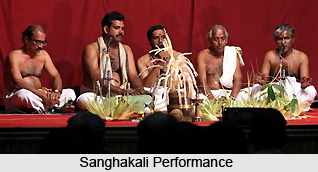
 Sanghakali is a group drama which is also known as Chattirankam, Sastrankam, Yatrakali, and Panenkali. This is a socio-religious entertainment of the Nambudiri Brahmans in Kerala. In the context, sangham has the added connotation of a group engaged in gymnastic practice. No authentic evidence survives to precisely fix the period when it evolved. Scholars think that the Nambudiris reached Kerala between the sixth and eighth centuries. However, the Sanghakali songs available now, in the mix of Malayalam and Sanskrit known as Manipravalam, can only claim an antiquity of about 600 years.
History of Sanghakali
Oral history says that Sanghakali originated at a time when the Nambudiris commonly practiced animal sacrifice in their rituals which was considered taboo by believers of Buddhism. Cheraman Perumal was the Buddhist ruler of the Chera dynasty in the tenth century. They forbade animal sacrifice and persecuted the Brahmans, who took refuge in a temple at Trikkariyur village. An unknown ascetic visited them and advised them to form a congregation to recite the nalupadam mantra representing the quintessence of the four Vedas, for fulfilment of their mission. The Nambudiris who assembled at the conclave finally organized themselves into a militia to fight the ruler.
Implications of Sanghakali
Sanghakali has ritualistic as well as artistic implications. The performance is called satram, which denotes a holy sacrifice of long duration. This ritual used to be conducted as a family function in connection with marriages and other ceremonies such as feeding children their first meal, naming them, or investing a Brahman boy with the sacred thread.
Performance of Sanghakali
On the night before the satram, the frontage of the house where the ritual takes place is decorated with a lit bell-metal lamp, betel leaves, areca nuts, coconuts, and flowers. The participants, in martial outfits, reach the gate to the accompaniment of drums. They offer salutations to the lamp, ceremoniously arm themselves with sword and shield, and sing the pukkulamala or `garland of flower clusters` in praise of the presiding deity of the village. In the morning, a percussion ensemble plays
At a music session in the afternoon, the participants provide rhythm to their own vocals on big copper vessels i.e. chembu turned upside down. After the evening bath and prayer, the nalupadam hymn is ceremoniously rendered in front of the lamp. This is known as the most significant part of the ritual. During dinner the group recites passages or kari slokas describing the delicious dishes served. The titturam vayana, or reading of the decree, comes next. This is a pronouncement on an epic or contemporary situation that enlivens the dramatic effect for the ensuing performance. Then the troupe sings vanchippattu or boat ballads recalling a historical chattiran exodus by sea.
The all-night performance before the lamp commences with an auspicious musical prelude. Many interesting characters appear, having the flavour of life. Kaimal, which is also known as Ittikkandappan, is a comic representative of decadent aristocracy. This is performed to make fun of his disreputable stand of siding with the ruler in persecuting the Nambudiris. Other characters like Muttiyamma i.e. old woman, Kallukudiyan or drunkard, and Kuratti or gypsy enter, fascinating the audience through dance, music, and dialogue. The performance has the nature of a variety show because it reflects, as if in a mirror, many popular arts and hence has a loosely-knit structure. The main appeal is its social satire and rich humour, besides artistic agility and gusto.