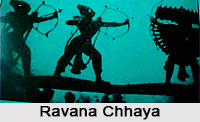
 Ravana Chhaya is a rare form of shadow-theatre surviving in Orissa. Before discussing Ravana Chhaya further, perhaps it would be useful to look into what exactly shadow-play implies. Shadow-play, which is also known as shadow-show or shadow-theatre, is different from all other forms of theatre, including puppet plays. On the human and puppet stages a real world of space is created in which actors or figures have direct contact with the audience. The effect of the shadow-play is always indirect although it is a form of puppetry in which flat figures, usually made of leather, are lightly pressed on a translucent screen with a strong source of light behind. The audience sits on the other side of the screen and sees the shadows moving when the figures are manipulated. Thus, spectators and actors separated by the light screen are placed as if in different rooms. The spectator is by himself and his feeling of isolation is heightened by the darkness all around. He does not directly experience the figures and the play; he only sees the image, the projection. The light screen is here most important as it filters and modifies the action. On the inner side of the screen, the actor (the one manipulating the puppets) too is isolated.
Among the four different types of shadow theatre surviving in India, Ravana Chhaya appears to be the most ancient. This is because the shadows have an unmistakable primitive quality and the performance is the least sophisticated. Besides, it is the only form of shadow-play in which the figures have no jointed limbs. This form of shadow play is mostly seen held in the rural areas. Earlier, the villagers used to believe that the performance of the Ravana Chhaya in the village could avert natural calamities like flood, drought and epidemic. Therefore, inhabitants of different villages used to contribute either in shape of their agricultural produces or money for holding a Ravana Chhaya show in the village at least once a year. Now with advancement of education villagers have started calling such belief as superstition.
It is interesting to note that though this style draws exclusively upon the legends of Lord Rama, its name comes from Ravana, his adversary. The usual explanation is that Rama, a god, hence a luminous being, cannot have a shadow. Therefore this shadow theatre is named after Ravana. This has led to the assumption that Ravana`s importance over Rama could reflect the influence of Buddhism and Jainism, the two religions that held sway over Kalinga i.e. ancient Orissa 2000 years ago. It is not known what version of Rama`s story Ravana Chhaya followed earlier, but for the last hundred years or so it has delivered the text of Vichitra Ramayana by Vishvanath Khuntia. Vishvanath Khuntia was a medieval Oriya poet.
The puppets used for this theatre form are made of opaque deerskin and cast black and white shadows in bold dramatic poses. To keep them straight, split bamboo sticks are attached vertically, which have a handle at the lower end. Many props such as trees, mountains, chariots, are also used to create appropriate `sets`. Ravana Chhaya figures are quite simple. Off screen they look neither artistic nor attractive, but their shadows formed by shimmering golden lamplight acquire a breathtaking beauty. Although small in size they create very powerful yet lyrical shadows, especially when manipulated in the puppeteers` peculiar jerky movement.
A bowl-shaped earthen lamp, filled with castor oil and lit with two thick wicks made of cotton rags soaked in oil, forms the light source. The lamp is placed on a stand made of a bamboo stick with a small wooden plank fixed to one side. The height of the stand is so adjusted that the lamp is about 30-37 cm from the bottom of the screen at the central line. The distance between light and screen is at most 30 cm. The manipulators raise the puppets in between while sitting on the ground. The leader stands on the other side of the screen in full view of the audience, singing and playing a Khanjani held in his hands. The Khanjani is a small frame drum. A vocalist often assists him from behind the screen. All of them deliver the impromptu prose dialogue for the puppets, but the soul of the performance is music. The songs admirably blend both folk and classical Odissi, specially the traditional Chhanda form in which all the poems of the Vichitra Ramayana are composed. Besides Khanjani, a pair of wooden castanets called Daskathi provides percussive accompaniment to the singing.
It is rather sad to note that this remarkable theatre form is fast losing popularity and is in the last phase of graying out. Unless some urgent steps are taken it may soon fade into oblivion.