


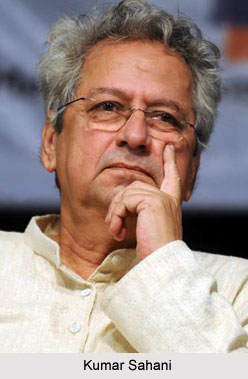
 Kumar Shahani is an avant-garde director whose films are characterized by the use of complex visual metaphors. Kumar Shahani belongs to the select few who are uncompromising in their treatment of the medium as an art form. Kumar Shahani is an avant-garde director whose films are characterized by the use of complex visual metaphors. Kumar Shahani belongs to the select few who are uncompromising in their treatment of the medium as an art form.
Many of his films are inspired by the art traditions of India. Born in 1940 in Larkana, Sindh (now in Pakistan), Shahani studied at the University of Mumbai and the Film and Television Institute of India (FTII), at which time the legendary filmmaker Ritwik Ghatak was the director of the institute. During 1967-68 he pursued further study on films in France, and worked as an intern on the director Robert Bresson's film Une Femme Douce (1969). There he studied in IDHEC in Paris. There he participated in a student rebellion in May 1968. Career of Kumar Sahani After returning to India, Kumar Shahani made his debut with Maya Darpan. This film was funded by the National Film Development Corporation (NFDC). Based on a short story by the Hindi writer Nirmal Verma, the film's remarkable screenplay and photography depicted the tensions underlying a feudal landscape in the process of being changed by industrialization and its implied modernity. After Maya Darpan, Shahani received no further funding for another twelve years. His next feature, Tarang, came in 1984. More melodramatic than Maya Darpan (1972), the film dealt with the theme of conflict between industrial profiteers and the working class. It featured a remarkable performance by actress Smita Patil. Shahani's next feature film, Khayal Gatha ( 1988), was an ambitious and visually dramatic film with its theme and form inspired by the different types of Khayal, an integral part of North Indian classical music. His next work, Kasba (1990), was based on a short story by Anton Chekov. It was a gripping melodrama about a small village's social politics. His made the Oriya film, Bhavantarana (1991), a partly fiction documentary on the Odissi dance form. In the year 1997 he worked on Char Adhyaya. His next venture was The Bamboo Flute (2000). His latest work is As the Crow Flies (2004). Filmography of Kumar Sahani * The Glass Pane (Diploma film, 1965) * Manmad Passenger (short film, 1967) * A Certain Childhood (short film, 1969) * Rails for the World (short film, 1970) * Object (short film, 1971) * Maya Darpan (1972) * Fire in the Belly (short film, 1973) * Our Universe (short film, 1976) * Tarang (1984) * Var Var Vari (short film, 1987) * Khayal Gatha (1988) * A Ship Aground (short film, 1989) * Kasba (1990) * Bhavantarana (1991) * Char Adhyaya (1997) * The Bamboo Flute (2000) * As the Crow Flies (2004) Awards of Kumar Sahani * Filmfare Critics Awards - Best Film (1972, 1990, and 1991) * The International Film Festival of Rotterdam - FIPRESCI Award (1990) * Prince Claus Award (1998) |
| |||



Home > Movies & Entertainment > Indian Movies > Movies in India > Indian Movie Directors > Kumar Sahani
Kumar Sahani
| Kumar Sahani is a well known Indian film director. He is popular for his film making that are characterised by complex visual metaphors. |
| ||||||||||||||||||||||||||||

