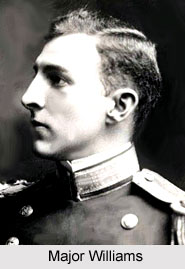
 In Mirath (Meerut) and the adjoining districts to the east, the treason of British authority had not been so complete as might have been expected. In Mirath (Meerut) itself authority had soon been restored. And, by the splendid energy displayed by Dunlop, by Brand Sapte, and others, successful attempts were made to re-establish the British power in the villages near it. In June the energetic Magistrate, Wallace Dunlop, had organised a troop of volunteers. It composed of officers without regiments, of members of the Civil Service, and of others who happened to be at Mirath (Meerut). Major Williams, Captain Charles D`Oyley, and Captain Tyrrhitt occupied the positions of commandant, second in command, and adjutant respectively. The officers were styled from the colour of the uniform adopted, the Khaki Risala. This troop, from the end of June to the fall of Dehli scoured the country, retook villages, punished marauders, and did all that was possible to restore and to maintain tranquillity. The Risala was often assisted by regular troops, cavalry as well as infantry.
The adjoining station of Saharanpur was administered by two men possessing rare capacity and great courage, Robert Spankie and Dundas Robertson. These gentlemen, cast upon their own resources, ably maintained order among a rebellious and stiff-necked people in extremely tricky circumstances. They also lent their aid to the adjoining districts.
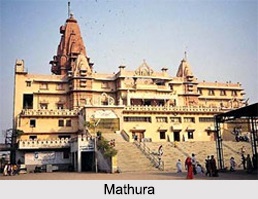
Equally successful were the efforts of H. G. Keene in Dehra Dun and R. M. Edwards in Muzaffarnagar. In Bulandshahr the splendid exertions of Brand Sapte restored order temporarily. But that station, Sikandarabad, Malagarh, and Khurja were so much under the control of the disaffected and turbulent Gujar population, that it was impossible to retain them permanently. It could only have been likely, when the fate of Delhi should be decided. The same state of affairs applies to Aligarh, to Gurgaon, to Hisar, and to the district of Rohtak. The country likewise between Aligarh and Agra, remained in a state of rebellion during that long period of uncertainty. This uncertainty was despite the splendid exertions of the Agra volunteers, and the country between Agra and Delhi, byway of Mathura.
In the province of Rohilkhand matters were even worse. From the districts and stations of Bijnaur, of Muradabad, of Badaon, of Bareilly, of Shahjahanpur, the English had been expelled under circumstances of great cruelty. This was accomplished with much shedding of innocent blood. Then a pensioner of the British Government, Khan Bahadur Khan, the descendant and heir of the last ruler of the Rohilahs, proclaimed himself Viceroy of the province, under the King of Delhi. He despatched the sipahis (soldiers) he had helped to corrupt, under the orders of Bakht Khan, a Subahdar of artillery, with the title of Brigadier, to Delhi. Bakht Khan subsequently became Commander-in-Chief of the rebel forces in the Imperial city. Khan Bahadur Khan governed the province for three and a half months. His rule drove to despondency all the honest men in it.
The province immediately adjacent to Delhi on the east, the province of Rohilkhand, with a population of over five millions, was absolutely held for the King of Delhi. While the Gujar villages between Mirath (Meerut) and the beleaguered city, and the districts of Rohtak and Hisar to the north of it, were in the possession of the insurgents. Mirath (Meerut), Saharanpur, and Muzaffarnagar were held with difficulty by the British. The country between Delhi and Agra had pronounced for the rebels. Central India, and the Sagar and Narbada territories were overrun by mutineers, while Rajputana itself alone remained true to its established fidelity. In a word, whether before Delhi, or in Mirath (Meerut) and the adjoining stations, or at Sagar and Mau, the British held only the ground occupied by their troops. There was yet a most important province to the north and north-west of the city, containing a numerous and warlike population, which had not yet declared itself. That province was Punjab. The question which was uppermost in every man`s mind was how long Punjab would remain dormant, Delhi being unsubdued.
Sir John Lawrence was at Rawalpindi when the telegraph flashed to him the story of the revolt of Mirath and the seizure of Delhi. He believed that, if promptly attacked by a British force, Delhi would succumb as readily and as promptly as it had succumbed in the time of Lord Lake. He endeavoured thus, by all the means in his power to impress upon General Anson the urgent necessity of marching to the rebellious city without smallest delay. He expressed the most unrestrained confidence in the immediate result of such a movement.
Sir John Lawrence impressed these opinions upon Lord Canning. In the fourth week of May, Lord Canning, under their influence, despatched the most emphatic orders to General Anson to make short work of Delhi.
Sir John Lawrence was indeed the author of the plan of campaign, the first object of which was the recapture of Delhi. No blame is due to him for having underrated the difficulties of such an enterprise. Delhi had become the heart of the rebellion. It was necessary to strike when the iron was hot. The step having been taken in conformity with his urgent solicitations, it became incumbent upon him to employ all the resources of the province he administered. To render the success of the enterprise absolutely certain was now a matter of honour.