


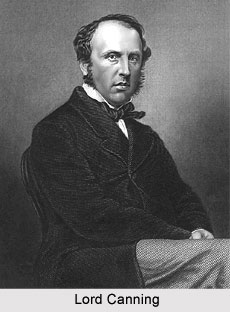
 In the third week of January 1858, Lord Canning quitted Calcutta for Allahabad, to assume there the administration of the Central Provinces. Freed from the pestilent influence of his Calcutta councillors, Lord Canning displayed at Allahabad vigour, wisdom, and energy in marked contrast to the narrow policy which had characterised his action. He reached Allahabad the 9th of February, and at once made his presence felt. The districts to the west and south of that place and Kanhpur (Kanpur) had been to a great extent cleared of the rebel bands which. In the third week of January 1858, Lord Canning quitted Calcutta for Allahabad, to assume there the administration of the Central Provinces. Freed from the pestilent influence of his Calcutta councillors, Lord Canning displayed at Allahabad vigour, wisdom, and energy in marked contrast to the narrow policy which had characterised his action. He reached Allahabad the 9th of February, and at once made his presence felt. The districts to the west and south of that place and Kanhpur (Kanpur) had been to a great extent cleared of the rebel bands which.
The invasion was successful by the united efforts of Carthew, Barker, and Campbell. Early in March moveable patrols were appointed, under the direction of Lieutenant-Colonel Christie. The main aim was to clear the district still more completely. By degrees the country to the west and north-west of Allahabad was quietened. But the districts to the east of it, the turbulent districts of Azamgarh and Juanpur, remained a danger to Lord Canning for some time after he had moved his headquarters to Allahabad. Meanwhile, Jang Bahadur had crossed the Gogra, at Pulpur, on the 21st of February. He marched forward on the 25th, and pushing on, reached the vicinity of Lakhnao (Lucknow). He was ready to cooperate with Sir Colin Campbell, on the 10th of March. In the interim, Franks's force, which was an amplification of Longden's, had been organised by the end of December. After temporarily clearing the Azamgarh district, it moved forward, hampered by the want of cavalry, on the 21st of January. At Sikandra, Franks came in sight of an enormous rebel force. It was the day on which it had been arranged that his cavalry should join him, the 22nd. He waited for them till the evening. To his delight, they came up, accompanied by four H. A. guns. There was no more hesitation. Early the next morning Franks attacked the rebels, and defeated them. Obliged in obedience to orders, to send back his cavalry to Allahabad, Franks moved to Singramao. He waited there until the arrival of Rowcroft at Gorakhpur should enable Jang Bahadur to advance. Then, Franks set out the same day, the 19th of February, in the direction of Sultanpur. He reached Chanda the same day, and inflicted a severe defeat on the rebels. Occupying Chanda, Franks pushed on to Rampura and halted there for two hours. Then moving to Hamirpur, he defeated another body of rebels, marching to the assistance of those disposed of at Chanda. Pushing on from there, he occupied the strong fortress of Budhayun in the face of the rebels, and completely defeated them in the hard-fought battle of Sultanpur (February 23). The Lahd Light Horse met Franks that evening, and the Jalandhar Cavalry the following morning. He pushed on rapidly after the battle. On 1st March Aikman, who commanded the Jalandhar Cavalry, heard of the presence of a rebel chief who had long been 'wanted' three miles off the road. Aikman dashed after him, caught him, killed more than a hundred of his men, and drove the remainder into the Gomti River. In the meantime, he had captured two of his guns. On the 4th of March, Franks had reached Amethi, within eight miles of Lakhnao (Lucknow). Hence he proceeded to attack the fort of Daurara, two miles from the road. But, in striking contrast to his usual strategy, he made the attack in a careless manner, and was rebuffed. It was unfortunate for Franks, for it was believed he was to have held the command in the storming of Lakhnao (Lucknow). Sir Colin, after becoming aware of the rebuff, conferred the command upon Outram. The assaulting army, numbering 20,000 men and 180 guns, were collected round the doomed city. |
| |||



Condition Of Allahabad
| Allahabad was the hotseat of rebellious activities, an extremely unsettling condition for the British. |
| ||||||||||||||||||||||||||||

