 On the 23rd of May, the 1st Madras Fusiliers, commanded by Colonel Neill, an officer of great decision of character, reached Calcutta. The regiment was despatched with all the expedition possible to the north-west. Neill reached Benaras, the morning of the 4th of June, at a very critical moment.
The city of Benaras lies almost midway between Calcutta and Delhi, being 469 miles north-west of the former and 485 south-east of the latter. The city lies picturesquely on the left bank of the Ganges, which, in 1857, was crossed by a bridge of boats. Benaras district of which the city is the capital has an area of 998 square miles. It is bounded to the north by Ghazfpur and Juanpur, to the west and south by Mirzapur, and to the east by the Shahibid district of Western Bihar.
During the pre-independence era, the garrison of Benaras consisted of half a company of European artillery of the Sikh regiment of Lodiana (present day Ludhiana, Punjab), and of the 13th Regiment of Irregular Cavalry. The cantonment for the infantry was at Sikrol, three miles from the city. The cavalry was some five miles distant. The force was commanded by Brigadier George Ponsonby, a man who had rendered excellent service in his day. But he had only just assumed command, and was suffering from ill-health and increasing years.
In 1857, Benaras received in person Frederick Gubbins of the Civil Service, then a District Judge. Some years before, when that gentleman filled the office of Magistrate of Benaras, he had inaugurated sanitary and other improvements within the city. However, . Gubbins, on the occasion of his next visit to the city, was barraged with a shower of stones, compelling him to run for his life. But Gubbins was however not the man to be baffled. He persisted in carrying out his reforms. The people, on their side, seemed equally determined. They closed their shops, and declined to sell grain or other wares. But Gubbins was firm. He procured supplies from Mirzapur. And when, three days later, he heard that the leaders of the movement were about to hold a meeting in the city, he proceeded to the spot with two companies of sipahis. He then arrested them, and lodged them in prison. The next morning he rode through the city and opened all the shops. From that moment he was the lord of Benaras.
In 1857, Henry Carre Tucker was the Commissioner of Benaras; but, from the moment affairs there assumed a jeopardising attitude, the strong character of Gubbins asserted itself, and he became practically supreme. Well supported by a team of trusted members, both British and native, he maintained order in the populous city until the arrival and action of Neill and his troops removed the pressing danger.
For very soon after the information of the events at Mirath (Meerut) and Delhi reached Benaras, it became clear that the sipahis (soldiers) of the 37th N. I. were infected, and would break out on the first convenient opportunity. They were somewhat restrained by the presence of the Sikhs, who were believed to be loyal to the core. Of the probable behaviour of the 13th Irregulars, few except the officers of that regiment entertained the smallest doubt. The position, then, was critical. It was recognised to be so especially by those civilians upon whom it fell to maintain peace and order within the city.
One resolution Gubbins and his friends stood by in the darkest hour of the crisis, and that was to remain at their post. In the early days proposals were made to abandon the position and retreat to the fortress of Chanar. But Messrs Gubbins and Lind, Gordon, who commanded the Sikhs, Dodgson the Brigade-Major, and one or two others opposed this plan so determinedly that it was abandoned. Nor did they veer a hair`s breadth from that determination, when the districts round and near to Benaras broke out into rebellion. The one precaution which, together with the military authorities, they did take was to fix upon a strong central post to serve as a place of refuge for the ladies and children. The mint, a large, oblong, fire-proof brick building, capable of holding out against men un-provided with guns, was selected for this purpose.
Towards the end of May, the English at Benaras were cheered by the arrival of 150 men of the 10th foot from Danapur. On the 3rd and 4th of June, Colonel Neill, with some sixty men of the 1st Madras Fusiliers, followed. On the morning of 4th, news reached the place of the mutiny of the 17th N. I. at Azamgarh. A council was then called of the chief civil and military authorities to consider the advisability of disarming the 37th N. I. Gubbins, Gordon, Dodgson, and all the bolder men were in favour of carrying out that necessary measure at once. They were listening to the strong recommendations of Gubbins on this point when Neill himself entered the room. In his plain, blunt way he insisted that delay would be fraught with impending danger. Orders then were issued for a parade of the troops of the garrison at five o`clock that afternoon.
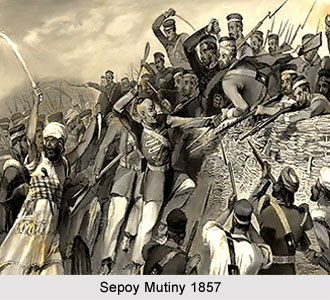
The lines of the 37th N. I. were in the centre of the general parade ground, almost midway between those occupied by the Sikhs and by the artillery. The question was how, with the 250 Europeans, the English were to disarm a native regiment, nearly a thousand strong. Before the men of the 37th had formed up in front of their lines, the artillery and the few men of the 10th and the Madras Fusiliers had taken up a position on their right. The Sikhs and the irregular cavalry were positioned on their left. Colonel Spottiswoode and the English officers of the 37th then walked down the lines of their regiment, and directed the men to lodge their muskets in the bells of arms attached to each company. Some of them quietly obeyed. But others, calling out that the Europeans were coming to shoot them down unarmed, egged the rest to resist. Their appeal was responded to, for suddenly the sipahis grasped their muskets to take action. Noticing the Europeans approaching from the right, the fighters faced towards them and opened a fresh firing.
At the first fire some eight men of the 10th foot were shot down. This was more than could be borne. The English infantry returned the fire, still moving on, while the guns poured in a volley of grapeshots. Meanwhile, a shot from a sipahi of the 37th had killed Captain Guise, commandant of the 13th Irregulars. Dodgson, the Brigade Major rode up to the men, and taking command, ordered them to advance. Instead of obeying, one trooper drew his pistol and fired at Dodgson. Another attempted to cut him down. At this crisis one of the Sikhs fired upon his colonel, Gordon. The rest of them, not knowing apparently what to make of the position, began shouting and firing indiscriminately. Their muskets were levelled in the direction in which the guns were posted. The guns were unsupported, for the English infantry was following the 37th N. I. It appeared as though the Sikhs and the irregulars were about to charge them. But the commandant of the artillery, William Olpherts was quite capable of the occasion. He turned the fire of his battery upon the Sikhs. The Sikhs then were wildly charged, only, however, to be broken and to flee in disorder. The troopers of the 13th accompanied them. The men of the 37th N.I. were already dispersing in wild disorder.
But the danger was not yet over. So clumsy had been the programme that the sipahis (soldiers) had been allowed to escape, with arms in their hands. They escaped in close vicinity to a populous city, the inhabitants of which were renowned for their turbulent character. In this crisis Frederick Gubbins, Surat Singh, Devnarain Singh, and other loyal men were able to render splendid service. The Sikhs on guard over the assembled non-combative Europeans were pacified by Surat Singh, himself a Sikh. Gubbins, entering the city, exerted his supreme influence. The citizens preferred to trust him rather than cast in their lot with rebellious sipahis. His forceful action, that of Surat Singh, supported by Devnarain Singh, Raja of Benaras, and by Pandit Gokal Chand, preserved the great city of Benaras to the British.
Meanwhile, Neill was not idle. In the midst of the contest he had assumed command. Some of the 13th Irregulars had remained faithful. The Sikhs, recovering from their crazy escapade, returned to their duty. The indigo planters of the district, prominently F. C. Chapman, volunteered their services. In a few days order was restored in the immediate environs of the holy city. The presence of Gubbins and his companions was a verifier that order would not be again interrupted. Other European troops were coming up from below. On the 9th of June, then, Neill, full of firmness to save Allahabad and to recover Kanhpur (Kanpur), set out for the former place.