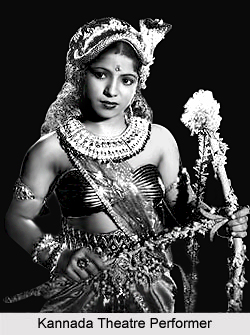
Adya Rangacharya was a renowned dramatist, novelist and scholar. He was also popular as an actor and director of Kannada theatre.
Early Life of Adya Rangacharya
He was born in the name of R. V. Jagirdar in 1904. But Adya Rangacharya is also known by his name de plume - Sriranga. Adya Rangacharya was a cultural icon of that era. Belonging to an established family of north Karnataka, he learnt Sanskrit at a young age. He went to Pune and the University of London for studies in linguistics, began working as a professor in India, and participated in the freedom struggle. Adya Rangacharya started his theatre career in the 1930s, actively associated with the amateur Kannada theatre as a director, and went on to write more than seventy one-act and forty-seven full-length plays. But unfortunately some of his works are still unpublished.
Life in Theatre for Adya Rangacharya
Adya Rangacharya`s drama has a variety of themes and techniques. As a means of social amelioration, it provided him an opportunity to expose social evils and laugh at human follies. Social realism and satire are generally the common features of his dramas. The Independence movement, Mahatma Gandhi`s influence, disintegration of the joint family, contradictions of society, religious hypocrisy of Brahmans, untouchability, poverty, unemployment, exploitation, extramarital affairs, form his major subjects. Even the relationship between the dramatist and the director or audience became part of his thematic concerns.
Plays Performed by Adya Rangacharya
Sriranga`s important plays can be broadly classified into four groups. Udara vairagya i.e. "Renunciation as Livelihood" in 1930, Vaidyaraja i.e. "Doctor-Raja" in 1932, Daridm Namyana i.e. "Narayana of the Poor" in 1933, Mukkanana virata punish a i.e. "Three-eyed Cosmic Man" in 1944 fall within the early period. Hari janwara i.e. `Tear the Sacred Thread` in 1934, Narakadalli Narahari i.e. `Narahari in Hell` in 1937, Shokachakra i.e. `Wheel of Sorrow` in 1952 belong to his idealistic Gandhian phase. The new wave brought disillusionment. The names can be mentioned as Kattale-belaku or `Dark-Light` in 1959, Kelu Janamejaya i.e. "Listen Janamejaya" in I960 and Dariyavudayya vaikunthake? i.e. "Which Way to Heaven?" in 1965. The later plays include Samagra manthana i.e. "Total Churning" in 1976, habeku iddujaysabeku i.e. "One Should Swim, Live, and Conquer" in 1977 and Agnisakshi i.e. "Fire-witness" in 1985. The plays by Adya Rangacharya are known for their loquacity. Like Sriranga, his characters indulge in endless talking. In this sense, he is often described as the Bernard Shaw of Karnataka. However, the dialogues are incisive and vituperative. Sriranga`s iconoclastic attitude often expresses itself through the sutradhara, not born of the dramatic situation. His statements, therefore, seem superimposed upon the characters and events, not organically blooming from the context. Many critics deplore this defect. Adya Rangacharya was basically interested in the moral dimension of human problems. His dramatis personae sometimes degenerated into mere sketches easily classifiable as white and black, the white characters not as substantial as the black ones. The action becomes rectilinear rather than complex or curvilinear as his very conception is marked by the principle of simplification. Preoccupied by ideas, formula, and stark realism, he fails to give an imaginative or symbolic elevation to people and situations or give them scope to grow on their own according to dramatic pressures. His characters, therefore, tend to be mouthpieces instead of having individuality or full-bloodedness.
Adya Rangacharya authored an autobiography, books in English on Indian theatre, and translated the Natyashastra into English and Kannada language. His arrogance equalled his brilliance and scholarship. Adya Rangacharya never tolerated any director taking liberty with his plays even in the slightest way. He used to cancel the show telegraphically if he came to know of such violations. In spite of these traits, Adya Rangacharya was a robust intellectual who awakened Kannada society from its smugness, sloth, and hypocrisy.
Adya Rangacharya died in the year of 1984.