 The New Indian Cinema is more of a movement, which is the mainspring of a renewal of aesthetics and vitality of themes in Indian cinema. The trajectories that sprouted in the sea of Indian cinema and the reels of celluloid that are associated with certain aesthetic sensibility , tinge of political awareness and engagement with political realities and a new style of film making seems to be the sky of new Indian cinema. It is also the reason that presently the Indian cinema is known to the outside world receiving and retaining global acclamation. However there are exceptions like Satyajit Ray, who was probably the only symbol of the Indian cinema to the outside India till the arrival of the New Cinema and who had actually merged the barriers of regional cinema with world cinema.
Some of the leading directors from this movement include Adoor Gopalakrishnan, Shaji, john Abraham from Kerala; Buddhadeb Dasgupta, Goutam Ghose, U. Chakraborty from Bengal; Balu Mahendru and K. Hariharan from Tamil Nadu; B. Bapu, Bongu Narsinga Rao from Andhra Pradesh; MS Sathyu, Girish Karnad, BV Karnath, Girish Kasaravalli from Karnataka and others. The New Cinema sprang from the fact that there was an aesthetic vacuum in the films of 1960s and 70s. The influence of the new cinema was widely felt on the regional films as well. The directors and actors of `new cinema` are but the products of the same.
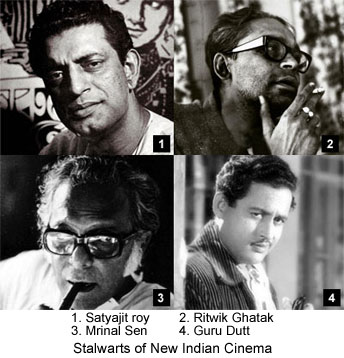
The aspiration of this new wave of filmmakers was to refuse to follow the rules of mainstream cinema and to work outside the commercial structures of Mumbai and other regional cinemas. Their beginnings are situated around 1970s. Their attempts to go beyond the mainstream movies were not completely new. From time to time such attempts have been made by the likes of Guru Dutt, Satyajit Ray, Mrinal Sen and Ritwik Ghatak and off course Shyam Benegal. For a long time these three Bengali directors were ignored by the Hindi film industry. But they were probably the main inspiration for the New Indian Cinema directors. A link, for example, has been traced between the works of Ghatak to that of Mani Kaul and Kumar Shahani.
Filmmaking in Marathi language, Gujarati language, Malayalam language, Kannada language as well as Oriya, Assamese and Manipuri were also affected by this new movement. All these led to the emergence of a new breed of directors known as the "auteur" directors all over the country. One might easily say that the New Cinema is a reflection of various objectives. These include the desire to adopt a linear narrative and a perspective, which is largely humanist and realistic in its manner of presentation.
The New Indian cinema is centred on common man. The heroes are hardly superhuman with outlandish ambition, those who have undergone the journey of poverty to wealthy status taming the rich girl and fight the evil landlord, but ordinary men and women acting under the pressures of ordinary living. It is a form of individualization as the characters no longer have to represent icons of society like the "suffering wife" or the "evil mother-in-law". This also explains why the form of these films is usually neo-realistic, though there is a great variety in the films of different directors.
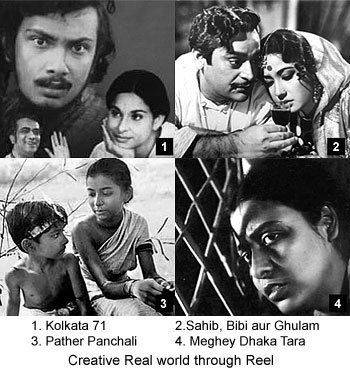 Unlike the popular cinema new cinema was a conglomeration of the social realism and psychological realism laying at par the correspondent reality and coherent reality.
Other factors include a deft psychological portrayal of the characters and basically an anti-establishment view of the social and political systems of the society. Sometimes these films came as a shock with the majority of the Indian audience because of their explicit sexuality, the avoidance of songs and dance unless absolutely necessary and several other exceptions made them unpalatable to the then audience. Such movies were often clubbed under the label of `art films.` the likes of Naseeruddin Shah, Om Puri, Smita Patil, Shabana Azmi, Deepti Naval, Mammooty, Mohanlal and others were associated with art films. The foreign neo-realistic films like Bicycle Thieves and the International Film Festivals in India have indeed contributed to this geocentric awakening.
Another director to have had a profound effect on the New Indian cinema is Mrinal Sen. Whether it is dialectical Marxism to culminating towards humanist philosophy, his films are imbued with both. Mani Kaul and Kumar Shahani were much more overt in their revolt against established traditions. Their most renowned films are Kaul`s Uski Roti (A Day`s Bread) and Shahani`s Maya Darpan. Shyam Benegal started as a neo-realistic humanist, and attacked the feudal and caste relationships that form an integral part of Indian culture.
However with time the concept of parallel or art cinema has undergone a major change. In the 21st century there is no demarcation between the arts of commercial films. Even mainstream films avoid songs and dances if the script does not require it. But the primary reason behind the cessation of such a demarcation is the audience`s readiness to accept good films without any discrimination.