


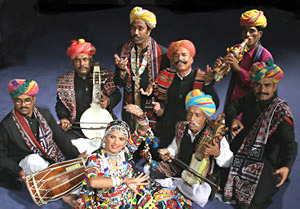
 Rajasthani language was spoken in the north-western state of Rajasthan. This is supposedly the ancient language of the eighth century. But as a matter of fact it did not develop any theatrical traditions apart from folk styles away from the courts, such as Khyal, Tamasha, or Rasdhari, and puppetry famous as Kathputli. Only as late as 1900, Rajasthani drama came into existence under the influence of Parsi theatre. Rajasthani language was spoken in the north-western state of Rajasthan. This is supposedly the ancient language of the eighth century. But as a matter of fact it did not develop any theatrical traditions apart from folk styles away from the courts, such as Khyal, Tamasha, or Rasdhari, and puppetry famous as Kathputli. Only as late as 1900, Rajasthani drama came into existence under the influence of Parsi theatre.
The beginning of the twentieth century brought in the era of social reforms and the national movement. Many social and historical plays written for the Parsi theatre became very popular. Some were banned and the playwrights imprisoned by the British government. Taking the cue from Parsi theatre, authors writing novels and short stories in Rajasthani also took to theatre. They thought it as a powerful weapon of propaganda against social and political evils. Through their plays, they tried to force society to react and eradicate these problems. Shiv Charan Bhartiya, who was the first Rajasthani dramatist, published Kesarvilas in 1900. This was followed by Budhapa ki sagai i.e. 'Old-age Betrothal' in 1906 and Phataka janjal or 'Snare of Future Trade' in 1907. In his introduction to Phataka janjal, Bhartiya wrote that his main aim was to show social evils to the Rajasthani people. Bhagwati Prasad Daruka wrote Vriddh vivah natak i.e. 'Play of Elders' Marriage' in 1903, dealing with old men wedding young girls, and Bal vivah natak i.e. 'Play of Child Marriage' in 1918. Other notable plays included Gulab Chand Nagauris Marivadi mausar aur sagai janjal i.e. 'Rituals of the Dead and Snares of Betrothal' in 1923 and Balkrishna Lahoti's Kanya bikri i.e. 'Sale of Girls' in 1938. Narayandas Agarwal made an interesting experiment in Maharana Pratap in 1924, where different characters delivered their dialogue in their own languages. The examples can be given as Maharaja Prithiviraj spoke the dialect of Bikaner, Akbar spoke in Persianized Urdu, Maharana Pratap and his courtiers in Mewari, and the Bhils who formed the core of Pratap's army used their tribal language. It can be well presumed that the work may have remained unstaged because in those days it was difficult to find actors speaking so many tongues. However, these playwrights neither could achieve their purpose of social reform nor could they develop a Rajasthani theatre. Most of them were not closely associated with theatre and were ignorant about the needs of the stage as well. Almost all their plays are unstageable, with too many small scenes and occasionally very long speeches. In Phataka janjal, one character expounds for eleven pages. The Parsi theatre did not take up these plays for two reasons. As for example first, they were unsuitable for professional theatre and, second, it was a national theatre movement that gave importance to Hindi and Urdu. It did not cater to drama in regional languages, although it influenced most regional theatres and later the films. Thus most Rajasthani plays were just staged sporadically by amateur groups and failed to reach the masses. They remained in published form to be read. Today, several young dramatists are writing in Rajasthani, notable among them Arjun Dev Charan, and directors like Bhanu Bharti have conducted research into such local forms as the Gavari, performed by the Bhils. But as yet the efforts to develop a Rajasthani theatre have not met with much success. |
| |||



Home > Movies & Entertainment > Indian Drama & Theatre > Regional Theatre in India > Rajasthani theatre
Rajasthani theatre
| Rajasthani theatre as a popular theatre form was formed in the late nineteenth century. |
| ||||||||||||||||||||||||||||

