|
 The radio play in India is an exclusively twentieth-century phenomenon. It mainly exists because of the need of a new medium of communication. Its form and structure were determined by the constraints of that medium. The brief existence of Madras Presidency Radio that was established in 1924 and the installation of broadcasting stations in the cities of Bombay, Calcutta, Delhi, and Madras signalled the possibilities of a new performatory genre. In the 1940s, dramatic presentations were seriously considered as important components of radio entertainment programmes, and the proper history of the radio play in India began. Professional playwrights did not realize its potential, nor was it visualized by drama critics of that time. The radio play in India is an exclusively twentieth-century phenomenon. It mainly exists because of the need of a new medium of communication. Its form and structure were determined by the constraints of that medium. The brief existence of Madras Presidency Radio that was established in 1924 and the installation of broadcasting stations in the cities of Bombay, Calcutta, Delhi, and Madras signalled the possibilities of a new performatory genre. In the 1940s, dramatic presentations were seriously considered as important components of radio entertainment programmes, and the proper history of the radio play in India began. Professional playwrights did not realize its potential, nor was it visualized by drama critics of that time.
Writers were closely associated with the government-owned All India Radio (AIR). Some of them highly gifted litterateurs were the first to experiment. Predictably, uncertainties and imperfections marked the first phase of radio drama. It took time to acquire the necessary techniques to exploit intelligently the medium of sound and silence, to compensate for the absence of the visual aspect. Quite often, early producers used existing plays with necessary emendations to meet the requirements, with considerable success. The famous Urdu authors Saadat Hasan Manto and Upendra Nath Ashk, the Gujarati dramatists C. C. Mehta and Shiv Kumar Joshi, the Bengali popular writer Birendrakrishna Bhadra are some of the named that can be mentioned. They significantly contributed to the popularity and development of radio drama.
Its establishment and growth depended on various factors, such as the condition of the theatre in different linguistic areas, etc. Growth was also dependant on the availability of short plays, professional dramatists' attitude towards the new genre, and general standards of entertainment. The success of radio plays in Urdu or Assamese, for example, is mainly because of limited stage activity. One Assamese critic observed that it was the radio that kept some of their dramatists busy. Bhaben Saikia and Arun Sarma produced scripts prolifically for Assamese radio.
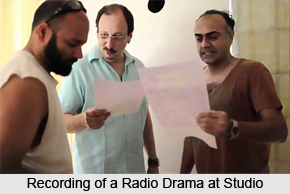 Kashmiri did not have any modern drama worth its name before the introduction of the language over the airwaves. Ali Mohammad Lone's radio serial Ti Vyath rozyipakan i.e. 'And Quiet Flows the Vitasta' was a landmark in Kashmiri theatre history. Radio offered a challenge to Urdu writers like Manto, Kishan Chander, and Rajinder Singh Bedi. Manto's celebrated play Ao i.e. 'Come' and Kishan Chander's Darwaza i.e. 'Door' were written specifically for the new medium. Kashmiri did not have any modern drama worth its name before the introduction of the language over the airwaves. Ali Mohammad Lone's radio serial Ti Vyath rozyipakan i.e. 'And Quiet Flows the Vitasta' was a landmark in Kashmiri theatre history. Radio offered a challenge to Urdu writers like Manto, Kishan Chander, and Rajinder Singh Bedi. Manto's celebrated play Ao i.e. 'Come' and Kishan Chander's Darwaza i.e. 'Door' were written specifically for the new medium.
Gujarati radio drama owes its origin and sustenance to C. C. Mehta and Shiv Kumar Joshi. The examples can be given as Mehta's Beti or 'Daughter' and Joshi's Atra lupta Saraswati i.e. 'The Saraswati Vanished Here' were acclaimed among the finest plays in the language. In Manipuri, the eminent G. C. Tongbra took this form seriously, gave it respectability, and made it a powerful medium to express complex experiences. However, radio drama is yet to gain scholarly attention. Despite the popularity of and critical acclaim for many Bengali and Marathi plays produced by AIR's Calcutta and Bombay stations, a recognized canon of scripts identified as a new genre has yet to emerge in either of these two important theatre languages. The Hindi radio play, too, depended on noted dramatists like Ram Kumar Varma, but critics raise doubts about its distinctiveness. Many scholars do not even know that Dharamvir Bharati's trailblazing Andha yug or 'Blind Age' in 1954. This was originally written for radio.
Radio drama made a significant impact on Indian popular culture. In the 1960s, AIR's commercial channel Vividh Bharati broadcast a short play in Hindi every day. This acquired a huge audience. Some scripts also outlived their immediate utility and left a lasting impression. The names can be mentioned as Va. Rao Iyenger's Tamil series Sorkattilsampasanai i.e. 'Dialogues in Heaven'. This was produced by AIR's Madras station in the 1940s and was published in 1964. K. V. Jagannatlians Timkkiiralvihikku was another popular radio play in Tamil. This is now available in different Indian languages. AIR requires nearly 4000 dramatic scripts annually as its major stations each broadcast about sixteen plays a month. In 1987, it introduced a national competition to encourage radiogenic scripts. By 1996, the competition was open to nineteen languages and awards were given in two categories. The categories were general and humorous.
|





