


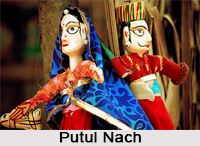
 Putul nach is an art form of Bengal. The literal meaning of putul nach is 'doll dance'. This is extended from West Bengal to Tripura and Assam. The oldest form can be said as the danger putul or rod puppets. This is found in South 24 Parganas district. The 1.5 m-tall figures, made of bamboo or hollowed wood, are jointed for easy manipulation with strings attached to various parts of their bodies. The nachiye or manipulator has a wooden cup attached to a waistband in which the rod supporting the large puppet rests. The troupe includes a singer who usually plays the harmonium and musicians on the clarinet, sanai or double-reed wind instrument, dhol, and kansi i.e. bell-metal plate beaten with a stick. This is often performed at rural fairs. The form uses an improvised proscenium and starts with the adoration of Krishna. A variation in Murshidabad district utilizes dolls made of bamboo and a round stage. Putul nach is an art form of Bengal. The literal meaning of putul nach is 'doll dance'. This is extended from West Bengal to Tripura and Assam. The oldest form can be said as the danger putul or rod puppets. This is found in South 24 Parganas district. The 1.5 m-tall figures, made of bamboo or hollowed wood, are jointed for easy manipulation with strings attached to various parts of their bodies. The nachiye or manipulator has a wooden cup attached to a waistband in which the rod supporting the large puppet rests. The troupe includes a singer who usually plays the harmonium and musicians on the clarinet, sanai or double-reed wind instrument, dhol, and kansi i.e. bell-metal plate beaten with a stick. This is often performed at rural fairs. The form uses an improvised proscenium and starts with the adoration of Krishna. A variation in Murshidabad district utilizes dolls made of bamboo and a round stage.
At the Sati Mela i.e. a fair named after Siva's consort in Kalyani, Nadia district, 15-20 cm rod puppets known as 'Yamer puri putul' (dolls from the palace of Yama, god of death) appear on a darkened stage viewed through bamboo slats. The shows are moralistic in tone, with instructions for various rites associated with the worship of Siva and advice for women. The benir putul or glove puppets are found at village festivals in Medinipur district. These have terracotta heads and wooden hands. They used to be played by palanquin bearers to while away their time between trips and to earn some extra money. The stories accompanying their 'dances' were normally about Lord Krishna. The puppeteers still perform without any stage, in full view, wearing their dolls on both hands. Putul Nach using marionettes made of pith, measuring 1 m and attached to four wires, has gone professional in Bagula, Nadia district. This was brought from Bangladesh by a refugee. His nam was Jiten Haldar, who saw such puppets at home in the possession of gipsy Rajasthanis. They became the means of livelihood for residents of Panchmura colony. The group has a repertoire of fifteen or sixteen plays based on the Mahabharata and Ramayana. These are mythological stories like that of Harishchandra, or even comparatively modern social scripts. It tours Bengali-speaking areas, beginning from Viswakarma Puja in autumn. The master puppeteer single-handedly sings all the songs and delivers the various dialogues, accompanied by musicians. The 1-m apron stage has a second tier for the manipulators. A variety of table puppet theatre is common among the tribal Adivasis of western Bengal. These employ small, dark marionettes of seasoned wood and bamboo, manipulated by a combination of rods and strings to songs accompanied by flute and drums. The Santals call this form chadar badar. Raghunath Goswami and Suresh Dutta contributed most to modern puppetry in West Bengal. Goswami, through his work with The Puppets, founded in 1953, tried to streamline the indigenous conventions and introduced a richer literary content, but remained loyal to native roots. He made the first Indian puppet movie named Hattagol vijay in 1952. The film won a national film award. Dutta, who trained under Russian genius Sergei Obraztsov, went for more gorgeous and illusory spectacle. In Tripura, Haripada Das invented contemporary rod puppets. Maldah district is the home of a highly unusual form known as manabputul or 'human dolls', in which actors imitate marionettes. It has hardly any narrative to speak of, mainly relying on the sheer humorous novelty of the concept. The performers sing, indulge in crosstalk, and mimic puppet behaviour, jumping and moving with limp limbs and jerky motions as if pulled by strings. Men usually impersonate the female puppets. |
| |||



Home > Movies & Entertainment > Indian Drama & Theatre > Forms of Indian theatre > Indian Puppet Theatre > Putul Nach
Putul Nach
| Putul Nach is termed as the puppetry in the Bengali-speaking region. |
| ||||||||||||||||||||||||||||

