Lord Pushpadanta, Jain Tirthankara - Informative & researched article on Lord Pushpadanta, Jain Tirthankara
 Indianetzone: Largest Free Encyclopedia of India with thousand of articlesIndian Philosophy


in  
 Art & Culture|Entertainment|Health|Reference|Sports|Society|Travel
Forum  | Free E-magazine  | RSS Feeds  
Indian Philosophy : Indian Philosophy |Schools of Indian Philosophy |Classical Indian Philosophy |Indian Religious Philosophy |Buddhist Philosophy |Upanishads |Indian Philosophers |Atomic Theories |Hindu Philosophy
Home > Reference > Indian Philosophy > Schools of Indian Philosophy > Jain Philosophy > Lord Pushpadanta
Lord Pushpadanta, Jain Tirthankara
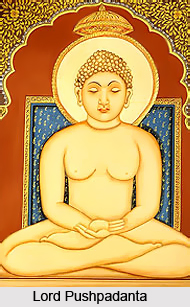
Lord Pushpadanta was the Ninth Tirthankara among the twenty-four Jain Tirthankars. He left all the worldly pleasures and attained nirvana.

 According to Jain philosophy, Pushpadanta was the Ninth Tirthankara among the twenty-four Jain Tirthankars. He is also known by the name Suvidhinath. Pushpadanta became a siddha, a liberated soul that has destroyed all of its karma.Pushpadanta, Jain Tirthankara

Lord Pushpadanta was born to Sugriva of Kakandi and Rama Devi in the Ikshvaku dynasty. He was born on the fifth day of the Margashirsha Krishna month of the Hindu calendar. In the tradition started by Bhagavan Rishabhdev the ninth Tirthankara re-established the four pronged religious ford was Bhagavan Suvidhinath. During his earlier incarnation as emperor Mahapadma of Pushkalvati Vijay purified his soul andf earned the Tirthankar-nam-and-gotra-karma.

Lord Pushpadanta took birth in the Vijayant dimension of gods. From the Vijayant dimension he descended into the womb of queen Rama Devi, wife of king Sugriva of Kakandi town.

Resurrection of Lord Pushpadanta
While Queen Rama was pregnant she experienced an extraordinary capability to develop processes for doing even the most difficult of tasks. Everyone got overwhelmed at her skill. When the child, Pushpadanta was born then Emperor, Sugriva named him as Suvidhi. During the teething period of the child the mother got a craving for playing with flowers. As such, he was also popularly known as Pushpadant or flower-tooth.

Pushpadant lead a normal princely life of luxury and pleasure but was always remained detached from them. He became an ascetic at an early age and attained omniscience only after four months rigorous spiritual practices. He achieved Nirvana at Sammetshikhar on the ninth day of the dark half of the month of Kartik.

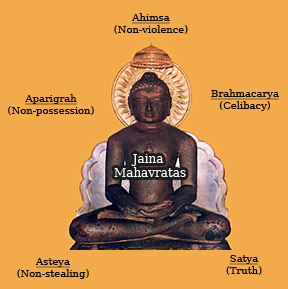
The tradition of the four pronged religious ford started by Lord Rishabhdev steadily became extinct after the Nirvana of Lord Pushpadanta. After his death, first the ascetic organization disintegrated and a time came when there was no ascetic left. The religious discourses too were given by common citizens or Shravaks. Slowly the influence of wealth became overpowering and people sbegan forgetting the principals of five vows including Ahimsa and truthfulness. The discipline of spiritual principles gave way to ritualistic exchanges of wealth and total indiscipline.

(Last Updated on : 14/04/2012)
 
 
Constituents of reality in Jain philosophy Metaphysics in Jain philosophy Milestones towards moksha, Jain philosophy
Morality and Ethics in Jain philosophy Nature of Divinity and God in Jain philosophy Path to Salvation in Jain Philosophy
Jain Symbols Social Utility of the Jaina Karmic Theory Classification of Karma
Karma in Jain Philosophy Dissociation of karma Cause of karmic bondage
Nirvana Lord Pushpadanta Pushpottara
Dravyas or Substances in Jain Philosophy Pudgala Basic Truths of Jain Philosophy
Body Functions Jain Reform Movement Action of the soul
Conduct of Life Types of Soul Conditions of Soul
Concept of Suffering Fourteen Gunasthanas Jain Cosmology
Anekanta Vada Syadvada Nayavada
Nigrantha Movement Shrimad Rajachandra  
Recently Updated Articles in Indian Philosophy
Second Chapter of Part Three
Second Chapter of Part Three of Brhadaranyaka Upanishad deals with the conversation between Yajnavalkya and Artabhaga.
Fifth Chapter of Part Two
Fifth Chapter of Part Two of Brhadaranyaka Upanishad deals with interdependence of created objects. It discusses about the effect of all objects on each other.
Fourth Chapter of Part Two
Fourth Chapter of Part Two of Brhadaranyaka Upanishad deals with the conversation between Yajnavalkya and Maitreyi where the former explains about the reality of Self.
Third Chapter of Part Two
Third Chapter of Part Two of Brhadaranyaka Upanishad describes about the two forms of Brahman, gross and subtle, mortal and immortal, limited and unlimited, definite and indefinite.
Second Chapter of Part Two
Second Chapter of Part Two of Brhadaranyaka Upanishad describes about the Prana. The vital breath in the body is the central life.
E-mail this Article | Post a Comment
Forum
Forum on Indian Philosophy
Free E-magazine
Subscribe to Free E-Magazine on Reference
 
 
Lord Pushpadanta, Jain Tirthankara - Informative & researched article on Lord Pushpadanta, Jain Tirthankara
Sitemap
Contact Us   |   RSS Feeds
Copyright © 2008 Jupiter Infomedia Ltd. All rights reserved including the right to reproduce the contents in whole or in part in any form or medium without the express written permission of
Jupiter Infomedia Ltd.