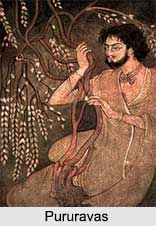
 Pururavas was a mythological entity associated with Surya (the sun) and Usha (the dawn), and is believed to reside in the middle region of the cosmos. He was a prince renowned for liberality, devotion, magnificence, love of truth and for personal beauty.
Pururavas and Urvashi
The love story of King Pururavas and Apsara Urvashi is found in the Sanskrit drama, "Vikramorvasiya", written by the celebrated poet Kalidasa. Pururavas was also called Vikram and the legend forms the subject of Kalidasa"s drama. Vikrama and Urvashi were the Hero and Nymph.
Many versions of the narrative of Urvashi and Pururavas are found in the Rig Veda, the Shatapatha Brahmana, the Mahabharata, the Vishnu Purana, the Matsya Purana and the Bhagavata Purana.
Love Story of Pururavas and Urvashi
Urvashi having incurred the curse of Mitra and Varuna, determined to take up her abode in the world of mortals and descending accordingly, beheld Pururavas. As soon as she saw him she forgot all reserve, and disregarding the delights of Swarga, became deeply enamoured of the prince. Considering her infinitely superior to all other females in grace, elegance, symmetry, delicacy and beauty, Pururavas was equally fascinated by Urvashi.
Both, Urvashi and Pururavas were inspired by similar sentiments, and mutually feeling that each was everything to the other, thought no more of any other object. Confiding in his merits, Pururavas addressed the nymph, and declared the love for her. Urvashi half averting her face through modesty replied that she has two rams and she loves them as her children. She will live with him if they are allowed to be kept near her bedside, and never suffered to be carried away. Pururavas must also take care of the rams never to be seen undressed and clarified butter alone would be her food. To these terms the king readily gave assent.
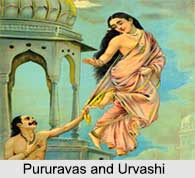 After this, Pururavas and Urvashi dwelt together in Alaka, sporting amidst the groves and lotus-crowned lakes of Chaitraratha, and the other forests there situated, for 61,000 years. The love of Pururavas for his bride increased every day of its duration. Urvashi"s affection for Pururavas equally increased in fervour, she never called to recollection residence amongst the immortals. Not so with the attendant spirits at the court of Lord Indra and nymphs and genii found heaven itself but dull whilst Urvashi was away.
Knowing the agreement that Urvashi had made with the king, Viswavasu was appointed by the Gandharvas to effect its violation. He came by night to the chamber where they slept, carried off one of the rams. Urvashi was awakened by its cries, and exclaimed who had carried one of the rams. Pururavas overheard her lamentations, but recollecting that he was undressed, and that Urvashi might see him in that state, did not get up from the couch. Then the Gandharvas came and stole the other ram and Urvashi, hearing it bleat, cried out that a woman had no protector who was the bride of a prince so dishonourable as to submit to this outrage.
This incensed Pururavas highly, and trusting that the nymph would not see his person, as it was dark, he rose and took his sword, and pursued the robbers, calling upon them to stop, and receive their punishment. At that moment the Gandharvas caused a flash of brilliant lightning to play upon the chamber, and Urvashi beheld the king undressed, the compact was violated, and the nymph immediately disappeared. The Gandharvas, abandoning the rams, departed to the region of the Gods.
Having recovered the animals, the king returned delighted to his couch, but there he beheld no Urvashi. He did not find her anywhere; he wandered naked over the world, like one insane. At length coming to Kurukshetra, he saw Urvashi sporting with four other nymphs of heaven in a lake beautified with lotuses, and he ran to her, and called her to return.
The nymph Urvashi said that she was pregnant, as she had shared one night with him. Pururavas seeing Urvashi was thus comforted returned to his capital. Urvashi said to her companions, that Pururavas was a prince with most excellent mortal and she lived with him long and affectionately united.
When the year had expired, Urvashi and the monarch met at Kurukshetra, and she consigned to him his first-born Ayus; and these annual interviews were repeated, until she had borne to him five sons. She then said to Pururavas, as a regard to her all the Gandharvas have expressed their joint purpose to bestow upon him their benediction let him therefore demand a boon. The Raja replied that all his enemies were destroyed. He had all his power, friends and kindred, armies and treasures. There is nothing, which he may attain except living in the same region with his wife Urvashi. His only desire therefore is, to pass my life with her. When he had thus spoken, the Gandharvas brought to Pururavas a vessel with fire, and said to him to take the fire, and, according to the precepts of the Vedas, divide it into three fires. Then fixing the mind upon the idea of living with Urvashi, offer oblations, and they shall assuredly obtain their wishes. The Raja took the brasier and departed, and came to a forest. Then he began to reflect that he had committed a great folly in bringing away the vessel of fire instead of his bride; and leaving the vessel in the wood, he went disconsolate to his palace.
In the middle of the night he woke up, and considered that the Gandharvas had given him the brasier to enable him to obtain the felicity of living with Urvashi, and that it was absurd of him to have left it by the way. Resolving therefore to recover it, he rose and went to the place where he had deposited the vessel, but it was gone. In its stead he saw a young Asvatta tree growing out of a Sami plant, and he reasoned with himself, and said, he left in this spot a vessel of fire, and now behold a young Asvatta tree growing out of a Sami plant. Verily he took these types of fire to his capital, and there, having engendered fire by their attrition he worshipped it.
Having thus determined, Pururavas took the plants to his city, and prepared their wood for attrition, with pieces of as many inches long as there are syllables in the Gayatri. Pururavas recited that holy verse, and rubbed together sticks of as many inches as he recited syllables in the Gayatri. Having thence elicited fire, he made it threefold, according to the injunctions of the Vedas, and offered oblations with it, proposing as the end of the ceremony reunion with Urvashi. In this way, celebrating many sacrifices agreeably to the form in which offerings are presented with fire, Pururavas obtained a seat in the sphere of the Gandharvas, and was no more separated from his beloved. Thus fire, which was at first but one, was made threefold in the present Manwantara by the son of Ila.
Descendants of Pururavas
According to the Puranas, Pururavas had six sons. The names of these sons are, Ayu (or Ayus), Amavasu, Vishvayu, Shrutayu, Shatayu and Dridhayu.