|
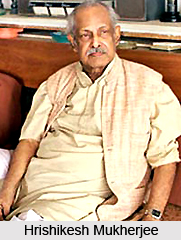 Hrishikesh Mukherjee was a Bengali non-conventional director, who made his first film in Mumbai in 1957, Musafir. It was a breakaway from the clich‚-ridden films of that period. In 1960 he made Anuradha, a new vision of feminine sensibility, with Leela Naidu and Balraj Sahni and music by Pandit Ravi Shankar. Transposed into the universe of commercial cinema, the story is that of an Indian Madame Bovary. Hrishikesh Mukherjee was a Bengali non-conventional director, who made his first film in Mumbai in 1957, Musafir. It was a breakaway from the clich‚-ridden films of that period. In 1960 he made Anuradha, a new vision of feminine sensibility, with Leela Naidu and Balraj Sahni and music by Pandit Ravi Shankar. Transposed into the universe of commercial cinema, the story is that of an Indian Madame Bovary.
Hrishikesh Mukherjee can be qualified as an auteur in the context of the Hindi commercial films. One of his best films and biggest hits was the 1970 movie, Anand, which starred the two megastars of 1970s and 1980s, Rajesh Khanna and Amitabh Bachchan. The credit for brilliant screenplay and music composition goes to Gulzar. This film was one of the first films in which a fatal illness and its effects on the lives of the characters are portrayed. A rare sense of humour and compassion was quite evident in the film. He hardly falls into the basket of a glamorous director, yet Hrishikesh Mukherjee may be stamped as the most popular and beloved filmmakers in Indian cinema. His magic hardly lays in glamour or largeness so often associated with cinema, but in its simplicity and warmth.
Directors like Hrishikesh Mukherjee dealt with the lives of common man. For a change the stories no longer revolved around larger than life characters neither did they escape the reality. Reality was once again been told but not in the way neo-realists, like, Guru Dutt portrayed it. There was an amalgamation of both hope and fear in his films. Open ended films also came into vogue and the tradition still continues.
Another film where the theme of illness is treated is Mili (1975). It starred Jaya Bachchan and her performance in this film was extraordinary. Alongside her the film had Amitabh Bachchan and stalwarts, such as, Ashok Kumar. Almost all the films of Hrishikesh Mukherjee dealt with common man and amazingly almost all his films were declared hit. Jaya Bachchan starred in most of his films, Abhimaan (1973, dealing with a married couple and their problems), Chupke Chupke (1975) and Guddi (1971). His other famous films include Satyakam (1969), Golmaal (1979), Khubsoorat (1980), Bawarchi (1972), Bemisal (1982), Namak Haraam (1973), Buddha Mil Gaya (1971), Rang Birangi (1983), Jhoot Bole Kauva Kaate (1998) and others.
Filmography of Hrishikesh Mukherjee
| Year |
Film |
| 1957 |
Musafir |
| 1959 |
Anari |
| 1960 |
Anuradha |
| 1962 |
Asli-Naqli, Aashiq |
| 1964 |
Saanjh Aur Savera |
| 1966 |
Anupama,Gaban |
| 1968 |
Aashirwad |
| 1969 |
Satyakam,Pyar Ka Sapna |
| 1970 |
Anand |
| 1971 |
Guddi |
| 1972 |
Bawarchi |
| 1973 |
Abhimaan,Namak Haraam |
| 1975 |
Chupke Chupke,Mili |
| 1979 |
Gol Maal |
| 1980 |
Khubsoorat |
| 1981 |
Naram Garam |
| 1983 |
Rang Birangi |
| 1998 |
Jhooth Bole Kauwa Kaate |
Editor, Writer and Associate Director
| Year |
Film |
Production Function |
| 1947 |
Tathapi |
|
| 1950 |
Maa |
|
| 1951 |
Do Bigha Zameen |
Scenario, Editor, Assistant Director |
| 1953 |
Parineeta |
Editor |
| 1954 |
Biraj Bahu |
Editor |
| 1955 |
Devdas |
|
| 1958 |
Madhumati |
Editor |
| 1959 |
Heera Moti |
|
| 1961 |
Char Diwari |
Editor |
| 1970 |
Dastak |
Editor |
| 1977 |
Alaap |
Story, Producer |
| 1983 |
Coolie |
Editor |
|





