


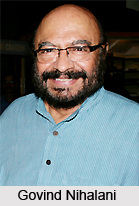
 Govind Nihalni started his career as a cinematographer with the film, Shantatal Court Chalu Aahe (1971). The film was directed by the Marathi playwright Satyadev Dubey. It was not before 1980 that he started to direct his own films. He quickly became a name to be reckoned with the New Cinema directors. Govind Nihalni started his career as a cinematographer with the film, Shantatal Court Chalu Aahe (1971). The film was directed by the Marathi playwright Satyadev Dubey. It was not before 1980 that he started to direct his own films. He quickly became a name to be reckoned with the New Cinema directors.
Early Life of Govind Nihalani Nihalani was born on 19 August 1940 in Karachi,of the Sindh province which is (now in Pakistan) and later his family migrated to India during the partition of 1947. He first started out as a cinematographer, getting his graduation degree in cinematography from the Shree Jaya Chamrajendra polytechnic in Bangalore in 1962. He was an Assistant Cinematographer to the legendary V. K. Murthy. He was associated with all the earlier films of Shyam Benegal and with the cinematography of Richard Attenborough's Oscar-winning epic Gandhi. Nihalani and Benegal are well known for their socially relevant films. His directorial venture initiated with Aakrosh starring Om Puri, Naseeruddin Shah, the late Smita Patil and the late Amrish Puri; based on a real story which was converted into a film script by the eminent Marathi playwright Vijay Tendulkar and it made a huge impact on audiences all over India. It shared the Golden Peacock for best film at the International Film Festival of India held in New Delhi in 1981. His film Ardh Satya, based on a story by S.D. Panwalkar, is still remembered by film lovers. It changed forever the way in which Indian cinema portrayed the police and it exposed in stark detail the police-politician-criminal nexus. Come 1997, and he adapted Bengali novelist, Mahasweta Devi' acclaimed novel by the same name to Hazaar Chaurasi Ki Maa 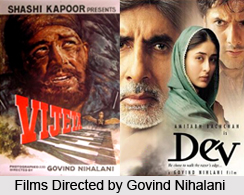 From the beginning Nihalani's conception of cinema was tied up with cinematography, which was his first area of interest, and many of his films received awards ands for this and other aspects of filmmaking. Some of his films, following they example of Benegal and Jabbar Patel, have been based on the screenplays by Vijay Tendulkar. The latter was one of the most important contemporary playwrights of the realist mode. These scripts were originally in Marathi. These stories usually revolved around political themes and the individual's dilemma in the circumstances, which arise from them. The sterling talent of Om Puri made him one of Nihalani's favourite actors. From the beginning Nihalani's conception of cinema was tied up with cinematography, which was his first area of interest, and many of his films received awards ands for this and other aspects of filmmaking. Some of his films, following they example of Benegal and Jabbar Patel, have been based on the screenplays by Vijay Tendulkar. The latter was one of the most important contemporary playwrights of the realist mode. These scripts were originally in Marathi. These stories usually revolved around political themes and the individual's dilemma in the circumstances, which arise from them. The sterling talent of Om Puri made him one of Nihalani's favourite actors.
In the last few years Nihalani's films have tended towards sensationalism of urban crime and the corruption of the powers that be. It brings out the public's disenchantment with the political system and their leaders, which had been growing since the 1970s. Since Tamas (1987), this director has worked more and more for television by making telefilms based on Indianised adaptations of Western playwrights, such as, Ibsen, Lorca and Strindberg. He has shot over 14 fiction films in Hindi, of which four are made for television. Some of Govind Nihalani's outstanding films include Aakrosh (1980), Vijeyta (1982), Ardh Satya(1983), Party (1984), Drohkaal (1994), Drishti (1990), Hazaar Chaurashi Ki Maa (1997), Thakshak (2000), Dev (2004) and others. Aakrosh had a cast which included some of the main actors of New Cinema of that time, Smita Patil, Naseeruddin Shah and Om Puri. The screenplay of the film was based on a real life incident. This political thriller denounced the treatment meted out to the 'adivasi'. Nihalani set high standards for making political thrillers. His films received wide acclamations and are till date remembered for their reality. The city of Mumbai was often treated as a background to his films which was undergoing profound changes where corruption was overriding social and political problems. Filmography of Govind Nihalni Aakrosh (1980) Vijeta (1982) Ardh Satya (1983) Party (1984) Aaghat (1985) Tamas (1987) - TV serial based on a novel by Bhisham Sahni. Cinematography by V.K.Murthy Drishti (1990) Pita (1991) Rukmavati Ki Haweli (1991) Jazeere (TV series) (1991) Karm Yoddha (1992) Drohkaal (1994) Sanshodhan (1996) Kuruthipunal (Tamil) (1996) (story) Hazaar Chaurasi Ki Maa (1997) Thakshak (2000) Deham (2001) Dev (2004) |
| |||



Home > Movies & Entertainment > Indian Movies > Movies in India > Indian Movie Directors > Govind Nihalani
Govind Nihalani
| Govind Nihalani is a name to be reckoned with the New Cinema directors. He started his career as a cinematographer with the film, Shantatal Court Chalu Aahe (1971). |
| ||||||||||||||||||||||||||||

