 The Puranas consider the identification of God with Universe, "A sense of Sublime/ Of something far more deeply interfused/ whose dwelling is the light of setting suns/ And the round ocean and living air/And the blue sky, and in the mind of man"-Wordsworth. Pantheism means `God is all` and `all is God`. It is believed that everything in this world is of an all-encompassing immanent abstract God or that the Universe, or nature, and God are equivalent. Pantheism is an oft recurred theme in Wordsworth`s poetry and works, and to be precise in the Romantic genre that kindred the propagandas of retreating to Nature. Pantheism is the view that the natural universe is divine, the proper object of reverence; or the view that the natural universe is pervaded with divinity. Negatively, it is the idea that one hardly looks beyond the universe for the proper object of ultimate respect. However, one of the chief clues to understand modern pantheism contains in the recurrent refusal to engage in anthropomorphism. "Anthropomorphism" refers to the practice of attributing familiar human qualities to objects outside us when there hardly any proof of such.
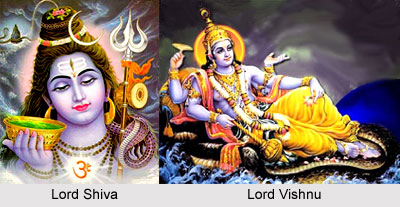
Pagans, before the advent of Christianity were pantheists, who worshipped natural entities. But there was a tendency, at least in the paganism of the past, to impose familiar human qualities on natural objects that may not have them, for example, to regard a tree as if it could perceive in the way that animals do or even as if it were a self-conscious being. Most contemporary pantheists would refuse to do this and would regard such an attitude as anthropomorphic. Hinduism both recognised pantheism and followed the same. The Hindu religious texts are the oldest known literature that contains Pantheistic ideas. Lord Vishnu and Shiva, or Shakti, whatever individual they undertake to glorify, is not only the remote and efficient, but also the proximate and substantial cause of the world. Hence in the Linga Purana, Brahma addresses Shiva as the Divine Ground of all things in this Universe.
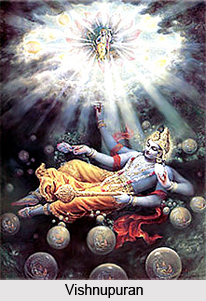
In the Vishnu Purana, the Pantheism says that this world was produced from Vishnu. The universe exists in him and he is the cause of its persistence and cessation. Thus, Vishnu Purana believes that this entire Universe is indeed Vishnu.
The Kalika Purana suggests that goddess Kali is identical with the universe, as well as distinct from it. Further in the Brahma Vaivartta Radha is praised as the mother of the world, and the world itself; as one with primeval nature. Expressions of this tenor occur in every page of the Puranas. Though something may be ascribed to the exaggerations of panegyric, and the obscurities of mysticism, yet the declarations are too positive and reiterated to admit of reasonable doubt. And it cannot be questioned that these writers confound the creature with the Creator and exposed themselves justly to the imputation of gross materialism. Pantheism relates to traditional Judaeo- Christian concepts of a God who by highlighting him as a mystery, beyond human comprehension; awe-inspiring; overwhelmingly powerful; creator of the universe; eternal and infinite; and transcendent. The divine universe fits some of these descriptions without modification and it fits others if we allow ourselves to interpret the terms flexibly.
The Puranas had borrowed the concept of the materialism from the Vedas. This is the concept that God is of one unity, with the individual personal gods being aspects of the One. Thus it is said that this whole world is Brahma, from Brahma to a clod of earth. Brahma is both the efficient and the material cause of the world. He is the potter by whom the fictile vase is formed. Brahma is the clay of which the whole universe is made-up. It is said that everything proceeds from him without waste or diminution of the source, as light radiates from the sun. All merges into him again, as bubbles bursting mingle with the air, as rivers fall into the ocean, and lose their identity in its waters. Like the web or spider is emitted from and retracted into itself, everything proceeds from and returns to him. This example and other similar illustrations speak the language of materialism too plainly to be misunderstood, although it mar be possible that the full extent of their signification was not intended, that these comparisons are not to be interpreted too literally. As in "Haiku" it is impossible to determine which precedes the other, so is this binary co-existence of the physical world with the nature, nature with god or Brahma, Brahma with human beings. Rabindranath Tagore had reworked upon the term Prakriti- or nature which reflects both physical environment and God well as the nature of million mortals, the behavioural pattern.
In Vedanta, particularly Advaita is a branch of Hindu philosophy, which believes different deities are seen by different adherents as particularly well suited to their worship. Advaita Vedanta says that multiple expressions of the one God or source of being, a view which is often considered by non-Hindus as being polytheistic.
The chief element of Advaita philosophy is Pantheism. Other sections of Vedanta do not firmly hold this principle. On the contrary the Dvaita school of Madhava holds Brahman to be the external personal Lord Vishnu, whereas the theistic school of Ramanuja supports Pantheism. Thus, Pantheism is reminiscent of Galileo who had once observed: "God is in us or nowhere", the human body an endorsement of five natural elements, and thus god!