


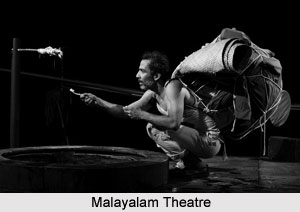
 Malayalam theatre is of ancient in origin, and is known even though the dramatic literature in Malayalam i.e. the language spoken in southern state of Kerala is of somewhat recent origin. Its oldest extant genre, Kutiyattam, fully established by the ninth century, may well represent the longest-surviving continuous theatrical tradition in the world. It is a system of staging classical Sanskrit plays, but not entirely Sanskrit theatre in the strict sense because the enactment contains elaborate oral elucidation in Malayalam. Still, it was Kerala's first performing art based on written texts, and evidently served as a basic model of creative expression for all later forms in Malayalam. Yet it also differs significantly from them in being conventionally presented on raised stages within auditoriums known as Kuttampalam. Malayalam theatre is of ancient in origin, and is known even though the dramatic literature in Malayalam i.e. the language spoken in southern state of Kerala is of somewhat recent origin. Its oldest extant genre, Kutiyattam, fully established by the ninth century, may well represent the longest-surviving continuous theatrical tradition in the world. It is a system of staging classical Sanskrit plays, but not entirely Sanskrit theatre in the strict sense because the enactment contains elaborate oral elucidation in Malayalam. Still, it was Kerala's first performing art based on written texts, and evidently served as a basic model of creative expression for all later forms in Malayalam. Yet it also differs significantly from them in being conventionally presented on raised stages within auditoriums known as Kuttampalam.
Origin of Malayalam Theatre Origin of Malayalam Theatre date back a long way to the 1893. A proper evolutionary history of modern Malayalam Theatre begins with the publication of the translation of Sakuntalam by Valiyakoi Thampuran in 1893. Its further development has been independent of the indigenous tradition and culture, as seen in its susceptibility to different theatre strains, native as well as foreign. But most of the ritual performing arts of Kerala, like Theyyam, Mudiyettu, Padayani, Koodiyattom etc. with their own performing texts, audience and literature, have a developmental history rooted in the indigenous traditions. History of Malayalam Theatre 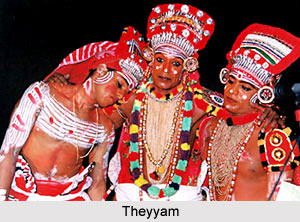 History of theatre culture in the Indian state of Kerala can be distinctly divided into two main types; Medieval Malayalam Theatre and Modern Malayalam Theatre, respectively! The history of Malayalam theatre is ancient in origin. This is known even though the dramatic Malayalam literature i.e. the language spoken in southern state of Kerala is of somewhat recent origin. Its oldest extant genre, Kutiyattam, fully established by the ninth century, may well represent the longest-surviving continuous theatrical tradition in the world. It is a system of staging classical plays in Sanskrit language, but not entirely Sanskrit theatre in the strict sense because the enactment contains elaborate oral elucidation in Malayalam language. Still, it was Kerala first performing art based on written texts, and evidently served as a basic model of creative expression for all later forms in Malayalam. History of theatre culture in the Indian state of Kerala can be distinctly divided into two main types; Medieval Malayalam Theatre and Modern Malayalam Theatre, respectively! The history of Malayalam theatre is ancient in origin. This is known even though the dramatic Malayalam literature i.e. the language spoken in southern state of Kerala is of somewhat recent origin. Its oldest extant genre, Kutiyattam, fully established by the ninth century, may well represent the longest-surviving continuous theatrical tradition in the world. It is a system of staging classical plays in Sanskrit language, but not entirely Sanskrit theatre in the strict sense because the enactment contains elaborate oral elucidation in Malayalam language. Still, it was Kerala first performing art based on written texts, and evidently served as a basic model of creative expression for all later forms in Malayalam.
Modern Malayalam theatre encompasses some of the interesting phase of theatre culture in the state. By 1900 one could visualize a gradual shift in the structure of sensibility of the people of Kerala, especially the educated middle class and the progressive minority. Contemporary Malayalam theatre has a rich heritage behind it, and has indeed come a long way from its past. Just like in any other part of India, Malayalam theatre has also seen a lot of growth in its field. Many theatre enthusiasts and critics felt that the theatre of Kerala did not yield the result as dreamed and expected. Some confusions and perplexity still remain among the people regarding the structure and from of the nature and the medium of production. Some critics are of the opinion that mad experimentation with the themes and plots of the plays have resulted in driving the audiences away. Development of Malayalam Theatre Development of Malayalam theatre can be categorically divided into various phases. The history of Malayalam theatre weaves together all the possible features of development in the state. The first social play in Malayalam may be said to be Mariamma (1903) by Kocheeppan Tharakan. Then there was the beginning of Tamil Theatre - tradition which owes its origin to the revival of Carnatic Music, by the then King of Travancore, Swathy Thirunal. During this time the decorative elements of Parsi Theatre also had been fairly pronounced on the Malayalam Theatre. Struck by the feeling that this imitative trend was inferior to the native culture, some outstanding playwrights of the time wrote some notable plays of the early period. Some of the important plays are Sangeethanaishatham by T.C. Achuthamenon, Sadarma by K.C. Kesava Pillai, Pakkanarcharitham by Vidwan Kelunayar. It was at this time that the Chavuttunatakam and Kalaripayattu elements found their way into the Malayalam theatre. Types of Malayalam Theatre Types of Malayalam theatre can be divided into three parts. Almost all the various types of stunning entertainment are characterized by a religious atmosphere, sometimes intrinsic and in other times extrinsic, which may be made the basis of division. So it can be fairly said that the types of Kerala theatre are; religious theatre in Kerala, semi religious and secular theatre in Kerala. More Information on Malayalam Theatre
|
| |||



Home > Movies & Entertainment > Indian Drama & Theatre > Regional Theatre in India > Malayalam Theatre
Malayalam Theatre
| Malayalam theatre with its richness in culture and tradition can claim an ancient theatrical heritage. |
| ||||||||||||||||||||||||||||

