Kanaiyalal Maneklal Munshi
|
Kanaiyalal Maneklal Munshi was a Gujarati author and statesman
|
|
|
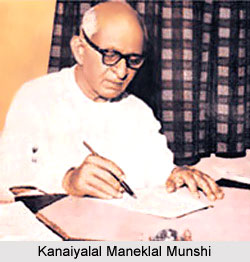 Kanaiyalal Maneklal Munshi was a great Gujarati scholar. He was an advocate by profession. He worked in the freedom struggle, edited Young India for a brief period, and helped Sardar Patel in the unification of princely states, later becoming Governor of Uttar Pradesh. He established Bharatiya Vidya Bhavan, the reputed organization for research and education in Indian culture. This organization's still-active theatre wing helped launch the 'new' Gujarati theatre in the early 1930s. The Gujarati scholar, Kanaiyalal Maneklal Munshi was a major novelist. He contributed decisively to drama both by writing and supporting productions. Theatre-loving friends like C. C. Mehta accompanied this action and the time was in the 1920s and 1930s. A box set was built for his play Kakani Shashi i.e. 'Uncle's Shashi' in 1929, discarding painted curtains for the first time, in a production by the Bhavan. Putra Samovadi i.e. "Daughter like Son" in 1929 was another important drama. Kanaiyalal Maneklal Munshi was a great Gujarati scholar. He was an advocate by profession. He worked in the freedom struggle, edited Young India for a brief period, and helped Sardar Patel in the unification of princely states, later becoming Governor of Uttar Pradesh. He established Bharatiya Vidya Bhavan, the reputed organization for research and education in Indian culture. This organization's still-active theatre wing helped launch the 'new' Gujarati theatre in the early 1930s. The Gujarati scholar, Kanaiyalal Maneklal Munshi was a major novelist. He contributed decisively to drama both by writing and supporting productions. Theatre-loving friends like C. C. Mehta accompanied this action and the time was in the 1920s and 1930s. A box set was built for his play Kakani Shashi i.e. 'Uncle's Shashi' in 1929, discarding painted curtains for the first time, in a production by the Bhavan. Putra Samovadi i.e. "Daughter like Son" in 1929 was another important drama.
The eminent Gujarati scholar, Kanaiyalal Maneklal Munshi wrote comedies too. The range includes Vavasbethnu sivatantrya i.e. Merchant Vava's Independence in 1921, Be Kharab Jan or "Two Wicked Persons" in 1924, filmed by Chimanlal Luhar in 1936, Brahmacharyashram i.e. "Celibacy Ashram" in 1931. Another segment was mythological drama like Purandarparajay or "Purandar's Defeat" in 1922 and Lopamudra 1933. During the 1930s, there was not a single college festival in Gujarat without a performance of one of his plays. Their characterization, dramatic dialogue, subtle comic sense, structure, and design always challenged directors and actors and made him popular with all sections of the audience. The Gujarati scholar, Kanaiyalal Maneklal Munshi exposed vanity and hypocrisy in farces like Chhiye Tej Thik or "Let's Be What We Are" in 1948 and Vah re men vah i.e. "Bravo, Myself" in 1949. He also wrote screenplays such as Dr Madhurika in 1935 and non-fiction in English.
Kanaiyalal Maneklal Munshi died in the year 1971.
This article is a stub. You can enrich by adding more information to it. Send your Write Up to content@indianetzone.com
|
|
|
|





