


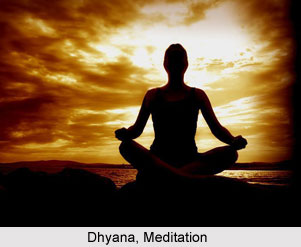
 Dhyana or meditation is a profound meditation stage in which the image of the vision meditated over, never departs from the mind of the sage. Dhyana is indeed the unification of essentially an inclusive and exclusive process where one withdraws his attention from all worldly objects while contemplating upon a chosen object, idol, sound or idea. Dhyana is a continuous process of a rather focused thinking where the mind and the body harmoniously functions as a whole. Dhyana is the ultimate state of intense awareness which is achieved whilst stilling the thought and by focusing the mind. In Dhyana what one gains is the insightful awareness through an acute and intuitive mind which further supports in controlling the responses and reaction. Dhyana or meditation is a profound meditation stage in which the image of the vision meditated over, never departs from the mind of the sage. Dhyana is indeed the unification of essentially an inclusive and exclusive process where one withdraws his attention from all worldly objects while contemplating upon a chosen object, idol, sound or idea. Dhyana is a continuous process of a rather focused thinking where the mind and the body harmoniously functions as a whole. Dhyana is the ultimate state of intense awareness which is achieved whilst stilling the thought and by focusing the mind. In Dhyana what one gains is the insightful awareness through an acute and intuitive mind which further supports in controlling the responses and reaction.
The expression "Dhyana" is a Sankrit word with its root in the terms "Dhi" and yana. Dhi means mind while yana means to move on or going. The unification of Dhi and yana in Dhyana thus refer to the journey of the mind. The exact meaning of Dhyana is therefore mental activity or the voyage of the mind. It is the process where mind journeys inward for the greater intention of identifying the self and for merging the self with the supreme consciousness. According to Agni Purana the word Dhyanam is derived from the root "Dhyai" to contemplate and denote the act of one's constantly meditating upon the divine self of Lord Vishnu, without the least digression of mind. Or in other words, Dhyanam means the communion of the self which is unconditioned by any category, with the Supreme Being (the Brahma), brought about by an act of will, and a voluntary application of attention. The history of Dhyana can be traced to the long gone days and the reference of it can be found in the Upanishadic thoughts and ideas. Although the early Vedic rishis did not coin the word, dhyana but it is through their spiritual experience that they were aware of the role of mind, the necessity to concentrate the thought process and the requirement to transcend the mundane reality whilst uniting with the Divine Reality. In those days, the Vedic seers practiced three different types of dhyana and were aware of three types of transcendental reality. Indications are there which proves that although in vedic hymns the term "dhyana" was not clearly mentioned yet the Rigvedic seers were aware of meditative and contemplative method of self analyzing. In Hindu philosophy the mind is the eternal receptor where thoughts, ideas, visions and imagery comes and recedes. Hindu tradition thus reveals that the human dhi or mind has the potency of the God itself as human being is reckoned as the totality of his thoughts, wishes, desires and ideas. According to Hindu tradition whatever one desires, grows upon him whilst making the individual a part of the latent impressions or samaskaras, influencing every aspect of his life, here and even here after. Quite ideally therefore all the mental actions are regarded as the part of their Karma. It is by manipulating the mental action, by instilling positive thought and by evolving pure ideas that individuals can evolve as much higher beings. It is believed in Hindu philosophy that even the animals have the ability to evolve into higher being through manipulating their mental focus. However, the question which torments the mind is how one can alter his mental focus and the Indian philosophy here attests Dhyana as that elementary base in manipulating focus and the corner stone in identifying the supreme self. Dhyana is therefore observing the flow of thought, the inward and upward movements of ideas. This observation of one's own thought can only be done in silence (maunam), stability (dhiram) and detachment (vairagyam). Agni Purana has said that the essential qualifications of a Meditator are knowledge, non-attachment, faith, forbearance, devotion to the god Vishnu, energy, and active habits. It has also been mentioned in the Agni Purana that Dhyana opens the gate of heaven for the meditator. The three types of Dhyana that have been mentioned in the Vedas are Mantric meditation, Visual dhyana and Contemplation. Mantric meditation: Through this type of dhyana the seers meditated whilst following the Vedic mantras with immense concentration. Visual dhyana: In visual dhyana the seer meditated on a particular deity with illumined thought. Contemplation: The seers meditated on the illumined insight residing in the heart and the mind. The six stages in the attainment of Dhyana are: * Yama, acts of restraint and obligation * Asana, sitting in particular postures * Pranayama, modes of breathing * Pratyahara, exclusion of all external ideas * Bhavana, apprehension of internal ideas * Dharana, fixation or retention of those ideas It can be said that through these six stages, dhyana becomes a journey into one's own self till one reaches the permanent reality where nothing but truth rests. In the Chandogya Upanishad the progressive forms of dhyana are further explained. It is said that " one should begin to meditate (upasana) upon the name (nama) Brahman, then the speech (vak), then the mind (Manas), then the cit consciousness (chitta), then contemplation (dhyana), then intelligence (Vijnyam), then strength (balam), then food (annam) , then water, heat and air." The idea of dhyana is thus to stabilize the mind, calm the thought through the process of mental focus and self contemplation in order to overcome both sorrow and joy while realizing the Supreme Being. In Katha Upanishad thus dhyana has been ideally portrayed as an effort of "realizing through self contemplation that Primal God, difficult to be seen, deeply hidden, set in the cave (of the heart), dwelling in the deepest. |
| |||



Dhyana
| Dhyana is a stage of meditation, which is a subset of Samadhi. With the help of Dhyana an individual is able to bring out liberation of his self. |
| ||||||||||||||||||||||||||||

