 A special session of the Indian National Congress was held in Calcutta on 4th September 1920 under the presidentship of Lala Lajpat Rai in which a proposal of non-violent non-cooperation was put up by Mahatma Gandhi, with the assurance that if the people followed his advice, he would get them swaraj within one year. The people responded to it. Even the revolutionaries, despite their dissimilar ideologies, joined the national mainstream wholeheartedly in the peaceful non-cooperation movement. However, the abrupt withdrawal of this movement by Gandhi after the Chauri Chaura incident on 5th February 1922 shocked them all.
The revolutionaries again marshalled their secret organisations and started recruiting youth, acquiring money and weapons to fight the ultimate battle with the ruling British. Led by Sachindernath Sanyal, who after his release from the Cellular jail in 1920 was leading a settled married life in U.P and Jogesh Chandra Chatterji, they floated the `Hindustan Republican Association`. Significant revolutionaries like Ram Prasad Bismil of Shahjahanpur, Ashfaquallah, Rajinder Lahiri, Chandra Shekhar Azad, Manmathnath Gupta and other devoted workers joined the association. Bejoy Kumar Sinha and Bhagat Singh were also closely associated with it. Its constitution was also framed. In January 1925, they distributed a pamphlet `Revolutionary` throughout the country, propagating revolution. Signed by Vijay Kumar, president Central Council of the Party, it distinguished `terrorism` and `anarchism` from revolution.
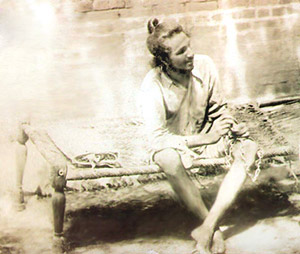
In Punjab, Lahore was once again agog with revolutionary activities and Bhagat Singh who was to become Shaheed-i-Azam in subsequent years was on the forefront. All the revolutionary groups from United Provinces, Punjab, Rajputana, and Bengal held a meeting in Feroze Shah Kotla grounds Delhi on 8 and 9 September 1928 which was attended by all important revolutionaries, including Bhagat Singh, Batukeshwar Dutt, Bejoy Kumar Sinha, Jatinder Nath Dass, Yashpal, Chander Shekhar Azad, Bhagwati Charan Vohra, Rajguru and Mahabir Singh. They rechristened the party as `Hindustan Socialist Republican Association`. Another wing, the `Hindustan Socialist Republican Army` was also formed with Chander Shekhar Azad as its chief commander.
The political developments took a speedy turn. On 30th October 1928, Lala Lajpat Rai was leading a huge procession towards the Lahore railway station, to protest against the arrival of `Simon Commission`. The police resorted to lathi charge and the baton blows hurled on Lala Lajpat Rai caused grave injuries on his body. It was protested vociferously in public. As a result of the chest injuries he suffered, he breathed his last on 17th November 1928 and joined the ranks of the martyrs. It spread a blanket of gloominess throughout the country. The revolutionaries instantly raised an avenging slogan, Khoon ka badla khoon, (Blood for Blood). The political atmosphere was surcharged throughout the country.
The revolutionaries planned to kill Scott, superintendent of police, Lahore. On 17th December 1928, exactly one month after the martyrdom of Lala Lajpat Rai, J.R Saunders an assistant superintendent of police was shot dead near the SP`s office and the D.A.V College, Lahore. Jai Gopal, Raj Guru, Bhagat Singh, Chander Shekhar Azad and Sukhdev carried out this mission and made a successful escapade. This gutsy act bewildered the authorities beyond measure.
Revolutionary activities continued in full vitality. From 1930 to 1933, in Bengal alone, twenty-three officials were killed and thirty-six were injured by the freedom fighters. Forty-seven murderous attempts, 167 attempts of robberies, 16 cases of bomb-throwing and 8 cases of bomb explosion by the revolutionaries took place in that province during that period.
The government resorted to tyrannical measures. Special Tribunals were set up by the provincial governments. The Bengal government requested the Government of India to allow them to deport the political prisoners to the Andaman and Nicobar Islands, despite the recommendations of the Prison Reform Committee to the contrary. In May 1932, Sir John Anderson visited the islands and recommended the use of the unnerving penal settlement in view of the relaxed discipline in the Indian jails. The primary complaint of the provincial governments was that the `terrorists` communicated with terrorist organisations outside, they did not observe jail discipline which had polluted the criminal convicts also, and that they attracted the press for their publicity. The Government of India decided to postpone the implementation of the recommendations of the Committee regarding the abolition of the penal settlement. On 12th July 1932, Sir Samuel Hoare, the secretary of state for India, announced in the House of Commons his approval to the proposal of the Government of India to transfer to the Andamans one hundred convicted `terrorists`. The policy decision of sending political prisoners to the horrendous `Kala pani` was strongly criticised by the public and the press, as it was against the spirit of the report of the Indian Jails Committee, 1919 (Cardew Committee) and their declared policy of abolishing the punishment of deportation. The monstrous gates of Cellular Jail were again waiting for the political prisoners to devour them up.
A batch of twenty-five political prisoners from Bengal including those convicted in the Chittagong Armoury Raid Case was the first batch to be transferred to the Andamans on 15th August 1932. Some more political prisoners were sent thereafter in 1932 and by the time of the hunger strike in April 1933, the number of political prisoners in the Cellular Jail was approximately one hundred according to B.K. Sinha. Kamalnath Tewari, Batukeshwar Dutt, Mahabir Singh, Kundan Lai and Dr. Gaya Prasad, all prisoners of Lahore Conspiracy Case were deported to the Andamans in January 1933. Jai Dev Kapoor, Bejoy Kumar Sinha and Sheo Verma reached the Andamans in June 1933. Fresh batches of political prisoners, whether lifers or short-term convicts, were sent to Port Blair thereafter. The political prisoners included not only those charged with murder or attempt to murder or convicted for dissemination of revolutionary ideology, but also those punished in minor criminal cases of political nature. They were all send off to the Andamans in large numbers.
Political prisoners convicted in Mechuabazar Bomb Case (Calcutta), Mymensingh attack on Ganja Liquor Warehouses, violent attack on Jhansi Commissioner, Armenian Street Political Dacoity, Atharabari Political Dacoity, Arms Act, Sialdah Political Dacoity, Alipore Political Dacoity, Barisal District School Political Dacoity, Faridpur Arms and Explosives Conspiracy, violent attack on Dhaka commissioner, Barisal Conspiracy Case, Brahanbaria Political Dacoity, Dhaka Political Dacoity, Charmaguria Post Office Dacoity, Aranyapasha Arms and Explosives Conspiracy, Dhol Ghat Encounter, Tangail Political Dacoity, Calcutta Arms Possession, Kulaseni Political Dacoity, Damodia Mail Robbery, violent attack on the Statesman Editor, Angaria Mail Robbery, Hill Railway Station Political Dacoity, Manikganj Mail Dacoity, Itkhola Mail Dacoity, Midnapore District Magistrate Murder Conspiracy, Naldanga Political Dacoity, violent attack on police informer, Badhua Political Dacoity, conspiracy to murder Bengal governor, Dinajpore Conspiracy, Birbhum Conspiracy, violation of Internment Order, Inter-Provincial Conspiracy, Gaibandha-Rangapur Arms Conspiracy, Alipur Conspiracy and in many more cases were also sent to the Andamans.
By the end of 1934, the number of political prisoners in the Andaman jail had gone up to 200. It is significant to note that although the sanction for deportation to the Andamans was originally restricted to one hundred prisoners only, political prisoners were deported indiscriminately without observing any constraint.
On 14th February 1935, the Home member of the Government of India stated in the Legislative Assembly that the total number of prisoners sent to the Andamans, after having been convicted of crimes connected with terrorism was 237 (208 from Bengal, 13 from Bihar and Orissa, 7 from Punjab, 6 from Madras and 3 from Delhi).
In October 1936, during the time of the visit of Raizada Hans Raj M.LA. and Mohammad Yamin Khan, M.LA. to Port Blair, the number of political prisoners in the Cellular Jail had gone up to 310. At one time, the number of political prisoners in. the Andaman jail had still exceeded, although by July 1937 their number had come down to 300, as some of them were repatriated due to illness or on the completion of their sentence. As per the list of political prisoners published by the Ex-Andaman Political Prisoners Fraternity Circle, 332 political prisoners from Bengal, 9 from U.P., 3 from Punjab, 18 from Bihar, 1 from Delhi, 3 from Madras and in all 366 were sent to the Andamans from 1932 to 1938.