Cult Films of Guru Dutt
|
The cult films of Guru Dutt uncover the depths of the filmmaker`s personality.
|
|
|
 The cult films of Guru Dutt uncover the depths of the filmmaker's personality and crystallize his aspirations, his phobias and his conceptions of cinema and life, revealing an irrepressible wish for death. The despair and pessimism of P.C. Barua’s ‘Devdas’ continues in his films. The cult films of Guru Dutt uncover the depths of the filmmaker's personality and crystallize his aspirations, his phobias and his conceptions of cinema and life, revealing an irrepressible wish for death. The despair and pessimism of P.C. Barua’s ‘Devdas’ continues in his films.
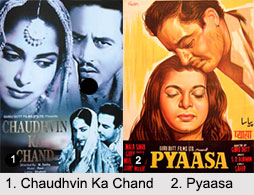
‘Pyaasa’ (1957), in which he himself played the role with Mala Sinha, a popular and talented star hailing from Nepal and born in Kolkata, was a brilliant success which brought him into the limelight. This film also brought to limelight one of the country’s finest actresses Waheeda Rehman. He introduced her in an earlier film ‘C.I.D.’ (1956). ‘Pyaasa’ was an enormous success among those Indian cinema lovers who were the most ardent fans of Bollywood musical films. The romantic melodrama has as its central theme the unquenchable thirst of an artiste, a lover wanting to be loved and recognised in an insensitive world ruled by money and power struggles. The music of S. D. Burman and the splendid Urdu ghazals composed by Sahir Ludhianvi are perfectly integrated by Guru Dutt with the plot and action in his film.
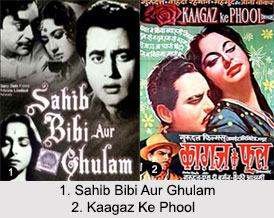 His next film, ‘Kaagaz Ke Phool’ (1959) presented a well-developed reflection on the place of an artist in the society. It was a further step towards pessimism, even nihilism and more autobiographical and premonitory than ever. This fascinating hymn to cinema is also a caution against its corrupting and artificial power. It tells the story of Suresh, once a filmmaker, who had become a dropout after failures and returns one evening into the deserted studio which was a witness to his fame. The lead roles were played by Guru Dutt and Waheeda Rehman. Rarely has an autobiography by a filmmaker been portrayed on the screen in a manner so intense. The film was a commercial failure for the public seemed to be put off by the character of the director and probably even more so by too sombre and lonely anti-hero. It was probably for the first time in the history of Indian cinema or at least Bollywood that the concept of anti-hero and tragedy were introduced in the mainstream. His next film, ‘Kaagaz Ke Phool’ (1959) presented a well-developed reflection on the place of an artist in the society. It was a further step towards pessimism, even nihilism and more autobiographical and premonitory than ever. This fascinating hymn to cinema is also a caution against its corrupting and artificial power. It tells the story of Suresh, once a filmmaker, who had become a dropout after failures and returns one evening into the deserted studio which was a witness to his fame. The lead roles were played by Guru Dutt and Waheeda Rehman. Rarely has an autobiography by a filmmaker been portrayed on the screen in a manner so intense. The film was a commercial failure for the public seemed to be put off by the character of the director and probably even more so by too sombre and lonely anti-hero. It was probably for the first time in the history of Indian cinema or at least Bollywood that the concept of anti-hero and tragedy were introduced in the mainstream.
In 1960, he produced ‘Chaudhvin Ka Chand’ in which he played the lead role alongside Waheeda Rehman and Johnny Walker. By the artifice of a love triangle intrigue, it is a film devoted to the decadence of the traditional art of living at the time of the Muslim Nawabs of Lucknow. The city was one of the shining cultural centres of the time and it was famous for its poetry, its musicians and its danseuses and courtesans. The film contains some beautiful songs written by Saghir Usmani with music by Shakeel Badaiyuni.
Another gem of Indian Cinema is ‘Sahib Bibi Aur Ghulam’ (1962), produced by Guru Dutt in a way it reflects his love for the Bengali culture as the film was adapted from Bimal Mitra's novel of the same name. The task of direction was entrusted to his colleague, scriptwriter and friend, Abrar Alvi. As is usual for Guru Dutt films it once again brought together some of the biggest names of the Hindi film industry, Meena Kumari, Rehman and Waheeda Rehman alongside Dutt. Three films, barring ‘Chaudhavin Ka Chand’, were three sinking projection of a suffering anti-hero, each time portrayed by Guru Dutt. In 1963 and 1964, he played the leading role in films of five other colleagues. After four attempts at suicide, Guru Dutt breathed his last in 1964, aged of 39.
|
|
|
|





