


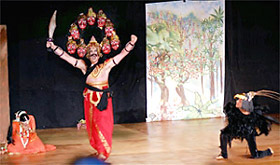
 In the realm of ancient Indian theatrical traditions, the Sanskrit theatre stands as a testament to the rich cultural heritage of the subcontinent. Sanskrit theatre, known as Nataka, encompasses all the elements of a dramatic composition, making it a paragon of the dramatic arts. Originating from the Sanskrit word 'nata,' which signifies a dancer, Nataka has been instrumental in shaping Indian literature, culture, and theatre for millennia. In the realm of ancient Indian theatrical traditions, the Sanskrit theatre stands as a testament to the rich cultural heritage of the subcontinent. Sanskrit theatre, known as Nataka, encompasses all the elements of a dramatic composition, making it a paragon of the dramatic arts. Originating from the Sanskrit word 'nata,' which signifies a dancer, Nataka has been instrumental in shaping Indian literature, culture, and theatre for millennia.
Heroic Characters of Nataka Nataka, much like the Greek tragedy, focuses on celebrating and highlighting important and illustrious figures. The central character of a Nataka is always a sovereign, such as the legendary Dushyanta, a demi-god like Rama, or a divinity such as Krishna. By centering the narrative around these elevated personages, Nataka reflects the grandeur and nobility inherent in its themes. Ten Types of Sanskrit Plays Within the ancient Sanskrit tradition, ten distinct types of plays are identified. These include Anka, Bhana, Dima, Ihamgra, Nataka, Prahasana, Prakarana, Svakarna, Vithi, and Vyayoga. Interestingly, only two of these types, Nataka and Prakarana, are mentioned in the seminal Natya Shastra, a comprehensive treatise on dramatic arts. Origin of Nataka Determining the precise origins of Sanskrit drama poses a challenge. While remnants of the earliest known plays can be traced back to the 1st century A.D., many scholars believe that the theatrical tradition in India predates this period significantly. Archaeological excavations do not provide definitive evidence of theatrical activity during the Harappan Civilization, which primarily focused on dance and music. Additionally, the ancient Vedic texts, spanning from 1500 to 1000 B.C., offer limited insights into drama, with only a few texts composed in rudimentary dialogue form. Bharata's Natya Shastra One of the most influential works on Sanskrit drama is Bharata's 'Natya Shastra,' believed to have been written between the 2nd century B.C. and the 2nd century A.D. This seminal treatise serves as a comprehensive handbook on all aspects of classical Sanskrit Theatre. Later, several other scholars contributed to the body of knowledge on drama and theatre, including Abhinava Gupta, Dhananjaya, Sagaranandi, Sharada Tanaya, Nandikeshwara, and many more. Nataka and Prakarana While the Sanskrit tradition recognizes ten types of plays, the 'Natya Shastra' primarily focuses on two: Nataka and Prakarana. Nataka plays include renowned works such as 'Swapanavasavadatta,' 'Uttaramacharitra,' and 'Shakuntalam.' Love and heroism reign supreme in these plays, which typically span between five and seven acts. On the other hand, Prakarana plays revolve around stories invented by their authors, centering on a hero and a heroine and emphasizing the theme of love. Key Elements and Structure of Nataka Nataka's chief characteristic portrays solemn and flawless actions of great importance through captivating language. Nataka embodies various elements of dramatic composition, presented not through narration but through the performance of actors, thus eliciting the gamut of human Nataka stands as a remarkable testament to the artistic brilliance of the Sanskrit theatre tradition. With its focus on exalted characters and grand narratives, Nataka has left an indelible mark on Indian literature and culture. From the Natya Shastra to the varied types of Sanskrit plays, the legacy of Nataka continues to inspire and captivate audiences. |
| |||



Nataka
| In Sanskrit, the play is known as Nataka par excellence, which comprises all the elements of a dramatic composition. It is an ancient Indian theatrical tradition that is closely based on themes of mythology and Indian epics. This Sanskrit drama has played a major role in sharing the Indian literature and culture for centuries. |
| ||||||||||||||||||||||||||||

