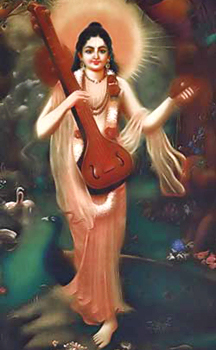
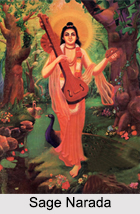
 Narada is a "Prajapati" or divine "Rishi" who born from the hip of Lord Brahma. The invention of the "veena", or Indian lyre, is attributed to Narada. Again a code of laws and one of the eighteen "Puranas" is entitled "Naradiya Purana". He is one of the greatest devotees of Lord Vishnu.
Legends of Narada
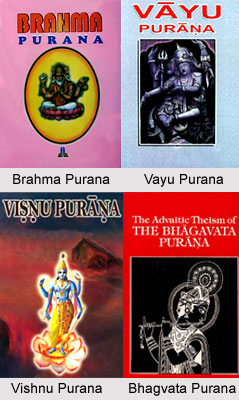
In the "Brahma Purana", Narada is called the smooth-speaking Narada, and his likeness to Orpheus is carried still further by a descent which he made from heaven to visit "Patala", the nether regions. In the "Vaishnavism", he is presented as a sage with devotion to Lord Vishnu. In Mahabharata, Narada is one of the "Gandharbas". It was he who persuade against the sons of Daksha from multiplying their race. Accordingly they scattered themselves through the regions of the universe to ascertain its extent. Daksha finding that all his sons had vanished was irritated and condemned an imprecation on Narada. It was Narada who informed Kansa that Lord Krishna was going to become incarnate as the eighth child of Devaki.
Once again when Narada visited Lord Krishna, he presented him with the flower Parijata from the world of the gods. In the Hindu legends, Narada is often described as bearing a resemblance to "Hermes" or Mercury, being engaged in conveying messages and causing discord among the Gods and men. He is usually represented as sitting in a fire, having his hands folded over his head, and stretching his legs also towards his head, his arms and knees being tied together with a girdle.
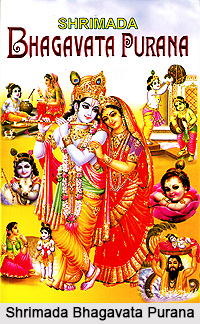
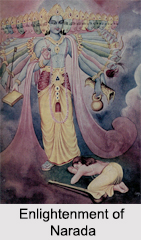 Bhagavata Purana" explains the story of Narada`s spiritual explanation. He was the key source of information among Gods and is believed to be the first journalist on Earth. After his mother died, he decided to travel the forest in search of enlightenment in understanding the `Supreme Absolute Truth`. After reaching a peaceful forest, looking for quenching his thirst from a nearby stream, he sat under a tree in meditation, concentrating on the "paramatma" form of Lord Vishnu within his heart as he had been taught by the priests he had served. After some time, he experienced a vision wherein Narayana (Vishnu) appeared before him. For the rest of his life, he focused on his devotion, meditation upon and worship to Vishnu.
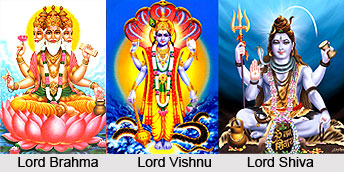
In "Shiva Purana", Narada once decided to perform self-punishment in a tranquil Himalayan cave. Then Lord Indra sent "Kama" (god of love) to disturb Narada`s self-punishment. However, due to Lord Shiva`s presence in Himalayas, Kama`s acts were unsuccessful. Narada thought his self-punishment was to be complete and became proud of winning over Kama. Narada swelling with superiority, boasts of his success over Kama before Lord Shiva. Lord Shiva through his erroneous powers creates a beautiful city in Narada`s path with a king named Shilanidhi ruling it. Narada entered Shilanidhi`s palace and learns about the "swayamvara" (choosing a husband) ceremony of his beautiful daughter named Shrimathi. Narada blessed her and takes leave but his mind still remained around the beauty of Shrimathi. He requested to Lord Vishnu to grant him his own form so that he could get Shrimathi as his wife. Lord Vishnu compelled and Narada got a body similar to that of Lord Vishnu but his face would be of a monkey. Unconscious of his monkey face, Narada attended Shrimathi`s "swayamvara". Shrimathi looked at Narada`s appearance and she was incapable to choose a fit husband among the assembled princes. Lord Vishnu appeared there in the form of a king and Shrimathi chose him. Then Narada looked at the mirror and angrily curses the two attendants to be born as demons in the family of a Brahmin. Narada left the city and saw his reflection in a stream and realized that his face has returned to normal. Then he went to Vaikunta and reproached Lord Vishnu and cursed him.
Narada is described as both intelligent and playful, in humorous mythological tales.