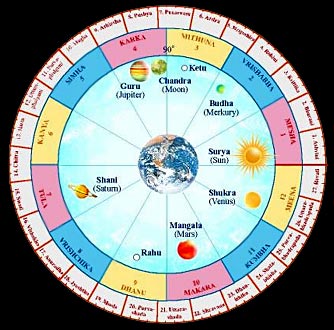
 The Nakshatras are considered by the Hindu astrologers as heavenly bodies, which have great influence on mankind. The Nakshatras have influence not only at the time of their birth, but during the whole course of their life on earth.
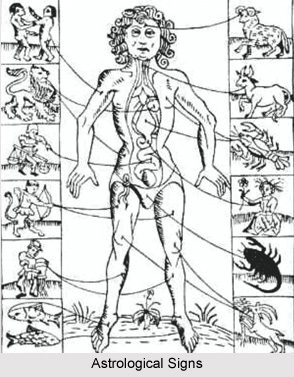
Nakshatras are said to comprise of the twelve signs of the Zodiac. In this the two and one quarter Nakshatras forming one sign. Again, they are also represented as demi-gods whose favour needs to be propitiated, and whose frown is fatal to health and life. The Nakshatras are a source of infinite terror to Hindus of all castes, and of vast emolument to the Brahmans. Nakshatras are consulted at births and marriages, and in all times of difficulty, of sickness, and of fretfulness. Journeys and expeditions are initiated under their direction. Furthermore according to their decision and designation, days and events become lucky or unlucky. The consultation of the Nakshatras is a part of the Hindu`s life, and is an important in his eyes as the institution of caste or the worship of the gods.
The Nakshatras are said to be twenty-seven in numbers. The word `Shanti` is attached to each and every Nakshatras to several names. It means `rest` or `quiet` and shows that the ill-natured deity, to whom it refers, requires a ceremony of conciliation to be performed in the event of a child being born at the time of her appearance in the heavens. This process is done in order that calamities and dangers, which she threatens to send upon the child, or its parents, or other relatives, or on its friends, or on its caste, may be avoided. Wherever the word `Shanti` is added, the particular danger, and the object of it, are likewise stated.
The lists of the twenty-seven Nakshatras are as follows:
• Aswani-Shanti, with this the danger is threatened to the parents of the child.
• Bharanf.
• Kritika.
• Rohini.
• Mrigashita.
• Argra.
• Punarvasii.
• Pushya-Shanti with this the danger is threatened to parents and other relatives.
• Ashlesa also known as Ashya-lekha-Shanti is a very powerful Nakshatra. Out of sixty hours during which she is dominant, only the last four are fraught with danger. If a child be born in the last of these, evil may happen to its father. If the child is born in the third, to its mother or if in the second, to itself and if in the first evil happens to its parents, to its brother, to its caste, and to wealth, if it has any.
• Magha-Shanti, danger is threatened to parents and other relatives.
• Purvaphalguni.
• Uttaraphalguni.
• Hasta.
• Chitra-Shanti, danger is threatened to the parents, and to the men of the same gotra or branch of families.
• Swati.
• Vishaka-Shanti, danger is threatened to the younger child of the father`s brother, if a daughter; and if a son, the danger will pass to the younger sister of his wife.
• Anuradha
• Jeishtha-Shanti is also a well-known Nakshatra. The sixty hours of its dominance are dangerous. The first six hours is threaten to the maternal grand-mother of the child, the second six, to its mother`s father, the third six, to its mother`s brother, the fourth six, to its mother, the fifth six to the child itself and lastly the sixth six, to all the members of the same gotra. Again the seventh six is harmful to its own family, the eighth six, to its brother, the ninth six, to its father-in-law and the tenth six, to all its relatives.
• Mul-Shanti is to a child, if the child is born during the first fifty-six hours of her dominance. This time danger impends over the entire family. In the fifty-seventh, danger threatens the father only. In the fifty-eighth the mother of the child is affected. And in the fifty-ninth the child itself is affected. The last hour, or the sixtieth, is devoid of danger, but nevertheless, requires Shanti.
• Purvashara.
• Uttarashara.
• Sravan.
• Dhanishta-Shanti. Danger is threatened both to its father and itself.
• Shatataraka.
• Purvabhadrapada.
• Uttarabhadrapada.
• Revati-Shanti is the Nakshatra in which the danger is threatened both to its parents and itself.