Monotheism in the Rig Veda is a constant refrain. It upholds the theory of one Supreme Being. It may be mentioned here that it is a common view of many Indologists that the Vedic religion is polytheistic. The basis for this view is that the hymns of the Rig veda speak of numerous deities (devatas) with diverse characteristics. Each deity is described as having individuality and a distinct status. According to one hymn the number of devatas is 3339. In another place in the Rik Samhita the deities are divided into three groups: (1) those who dwell in the heavens (dyuloka); (2) those whose abode is the mid-region (antariksa); and (3) those who reside on earth (prthivi). Their total number is counted as 33, eleven in each region. Therefore, on the face of it, it would appear that the religion of Rig veda cannot be considered monotheistic and that it would be difficult to accept the supremacy of Lord Vishnu.
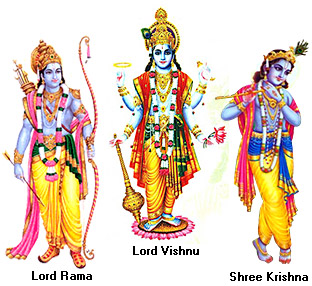
It has been pointed out in the Mahabharata that Narayana, the highest personal God, is the Supreme Being. All the deities are said to have been created by Him and all other deities are, therefore, parts (angas) of that one great Being. Another verse of the Mahabharata offers the same explanation upholding the supremacy of Lord Vishnu. Thus it states: "Vishnu is the unique and unparalleled Deity; He is the Supreme Being (mahabhuta); the other countless beings which are different from each other exist as His different aspects. He pervades all the three worlds and controls them but He Himself is untouched by their defects."
From these statements it is obvious that the numerous deities referred to in the Rig veda are no more than `functional appellations` of one fundamental Reality. It will be wrong to attach a meaning to the figures Three or thirty-three or three thousand. They are to be understood as figures of speech adopted by the composers of the Vedic hymns to convey certain truth which the seers had realized. This fact has been brought out by the Brhadaranyaka Upanishad in the dialogue between Sakalya and Yajnavalkya. In reply to a question addressed to the latter by the former regarding the number of gods, the number 3339 is reduced to 33, then to 3, later to 2, further to one and a half and finally to one. That one deity is described as prana or Brahman. The same Upanishad further explains that this numerical description of gods signifies the divine glories of one ultimate Reality.
The ancient Vedic commentators, Yaska and Saunaka, have adopted this explanation. According to Yaska only one Supreme Being is sung differently and all other deities are its different aspects. Saunaka, the author of Brhaddevata states: `There is but one deity. This deity has great powers and by its special powers it can assume many diverse forms. Hence the primary Reality which is the single Atman of the universe is described and praised under different names. Those who are described separately are part of this one Paramatman.` Sayana, the well-known commentator on the Vedas, also maintains the view that one Paramatman is praised through the different deities.
The view expressed by the Vedic commentators and the Mahabharata is not a later innovation as some scholars contend, to support the monotheism of the Rig Veda. There are hymns in the Rig veda itself, though these are fewer in number, which explicitly speak of the existence of one Supreme Being. Thus, an oft-quoted hymn states: There is one Being (sat) but wise men call it by different names (ekam sat vipra bahudhavadanti).
This is not the only stray statement but there are many others of this kind found in almost every mandala (part) of the Rig veda. A few instances may be stated here. In the very first mandala there is another hymn stating that the surya (sun) is the soul of the universe and its support. This emphasises the Upanishadic truth that the supreme Deity within the orbit of the sun is the controller of the entire universe as an in-dweller of the sentient and non-sentient entities. In the third mandala, the hymn emphasises the oneness of the deity by stating that the worshipful divinity of gods is one. In the fourth mandala the assertion of the Sage Vamadeva that "I am Manu, I am Surya, I am indeed everything" etc, refers to the unity of Reality". A hymn in the fifth mandala says that in whatever form He was seen in the same form He is described. In the sixth mandala we come across statements such as He is one to whom prayer is to be offered corresponding to the text of the Taittiriya Upanishad speaking of one ultimate Reality. Another text in the same mandala explicitly points out that there is one monarch of the world. A similar lucid statement can be found in the tenth mandala which points out that wise people describe in many ways the one existent principle. In another hymn it is stated that He who gives names to different deities is one Supreme Being.
The Rig Veda Samhita not only acknowledges the existence of one ultimate Reality in general terms such as sat, eka etc., but it also refers to the essential characteristics of the one Reality in the same terms as the Upanishads speak of Brahman. The Supreme one Deity is regarded as the primary cause of the universe (sarva-karana). He is considered as the controller of all (sarva-niyamaka and immanent in the hearts of men (antaryami). He is described as the ruler of the entire universe and the Lord of both the transcendental as well as the physical universe. He is referred to as the saviour of mankind and giver of immortality. We also come across other important attributes of the Supreme Being such as omniscient (sarvajna), omnipotent (sarvasakta), endowed with unsurpassable glory (sarvatisayi) and the greatest of all.
Though the hymns of the Rig Veda are addressed to different deities and are used to invoke them for sacrificial purposes they do contain philosophical thoughts. The Vedic seers who sang the glory of different deities were fully conscious of one Supreme Being who is the inner soul of these deities. As already mentioned, this truth has been well brought out by Yaska and other Vedic commentators. Further, according to the principle of interpretation adopted by the author of the Vedanta Sutra, when a prayer is addressed to a specific deity such as Indra or Lord Agni, it is not intended for that particular Being but on the contrary, it is meant for the Paramatman, the Supreme Being who is the in-dweller (antaratma) of that deity. From the philosophical standpoint the various names such as Indra, Agni, Viswadeva etc., denote ultimately Paramatman. The Katha Upanishad also declares that the entire Vedas speak of the swarupa of Brahman. All the different deities referred to in the hymns are, therefore, regarded as the different aspects or appellations of one Supreme Being. Thus, the religion of Rig Veda is basically monotheistic despite its reference to numerous deities.