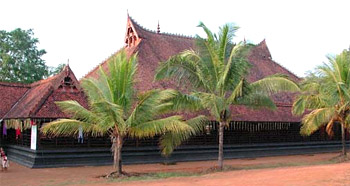
 Kuttampalam is the auditorium for the performance of Kutiyattam and Kuttu. It is built within temple complexes but outside the wooden temple barricade. Like the shrine, it is treated as a sacred space. Its architecture adapts the stipulations in the Natyosostm to local conditions. The entire gabled rectangular structure is elevated on sole and its superstructure of trellised wooden frames often has a door on each of its four sides. The large copper-plated or terracotta-tiled roof is supported on rows of pillars that are sometimes highly carved. In the central ridge at the top are three ornate finials each with a lotus bud, a symbol of auspiciousness. As one enters can see the space bisected roughly into halves. There is an open seating space and a square stage at one end, which faces the deity. The platform is ornate that rose on a plinth, and has a pillar at each corner supporting the stage roof. The Vatakkunnathan kuttampalam in Thrissur is the largest of these structures. It is 22 m by 15 m. This has three pillars near each corner of the stage, supporting a double ceiling. Possibly 1200 years old, it has a capacity of about 500. The lower face of the stage ceiling is carved with scenes from the epics and Bhagavata Pumna. In its centre is sculpted what Bharata calls the Brahma-mandala. This is a square containing nine squares, in which are installed the Ashtadigpalas i.e. guardian deities of the eight directions with Lord Brahma presiding in the central square as creator of the natyaveda. The carvings serve an acoustic purpose too. Wooden rafters and beams support the outer roof. In the back wall are two doors, one for entries of characters and the other for exits, behind which lies the dressing room. Two mizhavu copper pots held in frames stand between the doors. An over 1 m-tall bronze lamp, the nilavilakku, provides lighting. Of its three wicks, two point toward the actor and one toward the audience. However, the spectators squat in front of the stage as well as on the sides.
There is one Kuttampalam present at Irinjalakuda, in Thrissur district. This one measures 20 m by 16 m, and the one is present in Guruvayur i.e. Malappuram district. This one measures 10 m by 7 m, its stage covering only 9 sq. m. as well.