


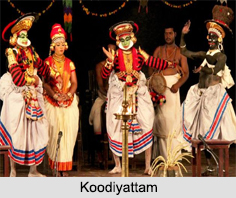
 Koodiyattam is the traditional Sanskrit theatre art form performed in the state of Kerala. Also transliterated as Kutiyattam, it is performed in the Sanskrit and Dravidian languages in Hindu temples and is the oldest classical dance forms in Kerala. The only surviving specimen of the ancient Sanskrit theatre, Koodiyattam has been recognised by the UNESCO as a Masterpiece of the Oral and Intangible Heritage of Humanity in 2001. The temples in which Koodiyattam was performed were specially designed temples called ‘Koothambalams’. Koodiyattam is the traditional Sanskrit theatre art form performed in the state of Kerala. Also transliterated as Kutiyattam, it is performed in the Sanskrit and Dravidian languages in Hindu temples and is the oldest classical dance forms in Kerala. The only surviving specimen of the ancient Sanskrit theatre, Koodiyattam has been recognised by the UNESCO as a Masterpiece of the Oral and Intangible Heritage of Humanity in 2001. The temples in which Koodiyattam was performed were specially designed temples called ‘Koothambalams’.
Etymology of Koodiyattam The name ‘Koodiyattam’ literally means playing or performing together. It is thought to refer to the presence of more actors on stage who act in consonance with the beats of the Mizhavu drummers. Alternatively, it may also be a reference to a common practice in Sanskrit drama where a single actor who has performed solo for several nights is joined by another. 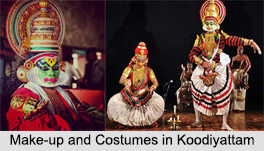 Origin of Koodiyattam Origin of Koodiyattam
Koodiyattam is believed to have originated 2,000 years before. This dance-drama form finds its mention along with dramatised dance form Chakyar Koothu, in the ancient Sangam literature of south as well as in certain ancient epigraphs. It is believed that Kulasekhara Varman Cheraman Perumal, an ancient king of the Tamil Chera dynasty, reformed Koodiyattam by introducing the local language for Vidhushaka as well as structured the presentation of the play to well-defined units. Plays of Koodiyattam Earlier, plays like ‘Subhadraharana’ and ‘Tapatisamvarana’ were staged. Along with these, the plays that are presented nowadays include ‘Ascaryacudamani’ of Saktibhadra, ‘Kalyanasaugandhika’ of Nilakantha, ‘Bhagavadajjuka’ of Bodhayana, ‘Nagananda’ of Harsa and many other plays which are accredited to Sanskrit playwright Bhasa, including Abhiseka and Pratima. Performance of Koodiyattam Koodiyattam has been performed traditionally by the Chakyars, a sub-caste of Kerala Hindus and by the Nangyaramma, women of the Ambalavasi Nambiar caste. The main actor is a Chakyar, who performs the ritualistic Koothu and Koodiyattam inside the Koothambalam. The Chakyar women known as Illotammas, are not allowed to participate. Instead, the female roles are played by the Nangyaramma. Koodiyattam performances are lengthy and elaborate affairs, ranging from 12 to 150 hours spread across several nights. A complete Koodiyattam performance consists of 3 segments - ‘Purappadu’ where an actor performs a verse along with the ‘nritta’ aspect of dance, Nirvahanam where the actor using Abhinaya, brings forward to the audience the mood of the main character of the play, taking the audience up to the point where the actual play begins like a retrospective and finally Koodiyattam, the play in itself. 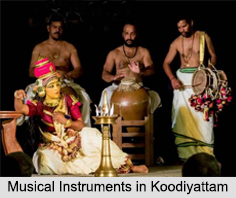 Musical Instruments in Koodiyattam Musical Instruments in Koodiyattam
The traditional musical instruments used in Koodiyattam are Mizhavu, Kuzhitalam, Etakka, Kurumkuzhal and Sankhu. The prominent instrument Mizhavu is a percussion instrument that is played by a person of the Ambalavas Nambiar caste. It is accompanied by the Nangyaramma playing the Kuzhithalam, which is a metallic musical instrument resembling a miniature pair of cymbals. Make-up and Costumes in Koodiyattam The costumes and make-up in Koodiyattam is quite elaborate. The costumes are a combination of bright colours mainly black, white and red which stand out. The face and eye make-up is quite dramatic. Heroic characters wear green colour paint and a small curved paper frame on their face. The Vidhushaka is dressed differently to set him apart from the rest of the artists. He has a different make-up with small head gear and his costume displays a clownish feature. Famous Artists of Koodiyattam Koodiyattam was an art form enacted only by Chakyar till the 1950s. Late Natyacharya Vidushakaratnam Padma Shri Guru Mani Madhava Chakyar is the most notable and recognised artist of Koodiyattam and was known for Rasa Abhinaya. The other most important exponent of Koodiyattam is Padma Bhushan Ammannur Madhava Chakyar. Mani Madhava Chakyar’s disciple and nephew Mani Damodara Chakyar is also a Koodiyattam performer. Ammannur Rajaneesh Chakyar is another Koodiyattam artist from Thrissur in Kerala. Sangeet Natak Akademi Award, the highest award was given to Koodiyattam artists like Kalamandalam Sivan Namboodiri in 2007, Painkulam Raman Chakyar in 2010 and Painkulam Damodara Chakyar in 2012. Decline of Koodiyattam Koodiyattam, having traditionally been an exclusive art form performed in special venues, the Koothambalams in Hindu temples, and its access having been highly restricted to only Hindus, is a dying art form in the current scenario. Also the fact that performances are lengthy taking as much as 40 days to complete is another reason for the art form’s decline. The collapse of the feudal order in the 19th century in Kerala led to a curtailment in the patronage extended to Koodiyattam artistes, and they faced serious financial difficulties. Following a revival in the early 20th century, Koodiyattam is once again facing a lack of funding, leading to a severe crisis in the profession. The Margi Theatre Group in Thiruvananthapuram is a notable organisation dedicated to the revival of Koodiyattam in Kerala. |
| |||



Home > Movies & Entertainment > Indian Drama & Theatre > Forms of Indian theatre > Classical Indian Dance Drama > Koodiyattam
Koodiyattam
| Koodiyattam is the oldest existing classical theatre form of the world. It has been recognised by UNESCO as a Human Heritage Art. |
| ||||||||||||||||||||||||||||

