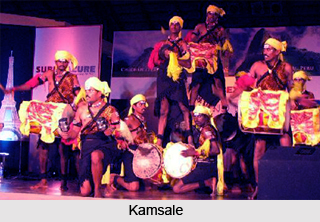
 Kamsale is a unique folk art performed by the devotees of God Mahadeswara in the Karnataka state of India. The origin of Kamsale is traced to the Mythological period. The word Kamsale is derived from Sanskrit kamsya tala i.e. `bronze cymbal`. Hence, `Kamsale` is a rhythm instrument and songs and dances are performed named after this instrument.
Performance of Kamsale:
Kamsales are played in pairs. Its size is about a man`s palm. They are throated at the centre. One which is convex in shape is held in one hand, while the other one is held at length.
Themes of Kamsale Song:
Although it has now come to include themes from several epics and legends, its dominant text continues to be the oral epic of the folk saint Maleya Madeshwara. This is believed to have lived sometime between the twelfth and fifteenth centuries, and its performers are followers of his sect. Most of the plots and episodes depict and celebrate his life and miracles.
Artists and Performance of Kamsale:
The Kamsale artists or dancers are found in the Kannada speaking areas of Mysore, Nanjagud, Kollegal and Bangalore. The artists in the Kamsale group vary from 3 to 8. If the Kamsale is accompanied by songs, the number of artists will be from 8 to 12. The static variety normally consists of one chief singer-narrator supported by two others. In Bisu Kamsale, the ensemble is larger and performs a vigorous dance, playing its main musical instrument, the cymbal, while simultaneously singing and narrating. The dances often turn acrobatic and the group weaves various choreographic patterns. The prose narrative rendered by the lead singer is equally stylized and robust, punctuated by shouts and exclamations from the others. At the end of each section the prose is energized and turned into song and dance again.
The Kamsale dance is named after the instrument held in the hands of the dancer. This instrument comprises of a cymbal held in one hand and a bronze disc in the other. The main element in the art is the rhythmic clang, which blends with melodious music of the Mahadeswara epic. The instruments, in the course of the vigorous rhythmic beatings are moved around the body of the dancer in innumerable patterns manifesting both skill and art. In a group movement, the dancer provides the vision of a series of offensive and defensive manoeuvres.
Although Kamsale is not a full-fledged theatrical genre, this represents a distinct branch of Kannada folk performance. An art form closely related to it is the Nilagara Mela, which presents the epic of another folk saint, Manteswami in a similar mode. Together, these forms express a different concept of theatricality from the much more publicized styles of Bayalata or Yakshagana.
Kamsale is closely connected with a tradition of Shiva worship. The artists who have vowed to live a life of devotion to lord Mahadeswara are supposed to perform Kamsale. The dance is a part of diksha or oath and is taught by the teacher and spiritual leader.