


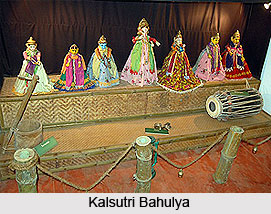
 Kalsutri Bahulya is a Marathi folk form, immensely popular till the early twentieth century. References to these puppets abound in ancient texts and saint poetry. Vishnudas Bhave, the pioneer of modern Marathi theatre, is known to have begun his career with puppet shows that he called Yamapuri. This means 'City of Yama' and this is named after the god of death. Today they have become almost obsolete, found only among some tribes like the Thakar, in pockets of Maharashtra. On the whole, tales coming from epics like Ramayana, Mahabharata, and Puran are usually passed inside most of this puppetry in an entertaining fashion. Kalsutri Bahulya is a Marathi folk form, immensely popular till the early twentieth century. References to these puppets abound in ancient texts and saint poetry. Vishnudas Bhave, the pioneer of modern Marathi theatre, is known to have begun his career with puppet shows that he called Yamapuri. This means 'City of Yama' and this is named after the god of death. Today they have become almost obsolete, found only among some tribes like the Thakar, in pockets of Maharashtra. On the whole, tales coming from epics like Ramayana, Mahabharata, and Puran are usually passed inside most of this puppetry in an entertaining fashion.
Creation of the Puppets The puppets are made of clay or carved from the light wood of the pangara i.e. coral tree. According to the character represented their height varies from 20 to 45 cm. Each figure is divided into two sections. The upper contains the head and torso, and the lower is draped in colourful cloth. Three strings are attached, one to the head and two to the hands. Dancers have two more strings tied to their legs, and demons, the tallest, have a string attached to their lower jaw, manipulated to open the mouth wide and shut it with a bang. Stage Preparations The show requires a specially prepared stage for which a 9-by-lm wooden frame is raised on a 1 m-high platform. The sides are covered and a 1 m-wide space is kept open for viewing. The Puppet Show In this classic type of puppetry, the puppeteer manipulates the dolls by means of wiring as well as strings. Tales of epics just like Mahabharata in addition to Ramayana are displayed inside these kinds of displays. The puppets move downstage and the sutradhara stands at the back with the strings in his fingers, unseen by the audience. At a time, four puppets can be made to perform. The actual puppeteer in addition makes use of his voice for the puppet personas of the story, often from the epics, to the accompaniment of various instruments such as tal or cymbals, the stringed tuntuni, and dholak. To turn out the show more entertaining as well as interesting vocals through community orchestra artists are employed. Some puppets, the kal bahulya, do not have long strings. They are carved hollow, with head and arms loosely attached by wooden sticks to the body, small strings tied to these limbs and gathered inside the back. The puppeteer puts his hand inside and manipulates the strings to move the arms and neck. These figures are beautifully decorated with ornaments, costumes, and flowers. Very often, this is a one-man show, in which the performer uses his left hand for the puppet and narrates or sings the tale to tal accompaniment in his right hand. As a result of insufficient reassurance, this particular precious historical past is within the verge of extinction. A few voluntary corporations have come ahead to help bring back this particular dyeing art. |
| |||



Home > Movies & Entertainment > Indian Drama & Theatre > Forms of Indian theatre > Folk Theatre In India > Kalsutri Bahulya
Kalsutri Bahulya
| Kalsutri Bahulya literally means `string puppets` and is a popular folk theatre form of Maharashtra. |
| ||||||||||||||||||||||||||||

