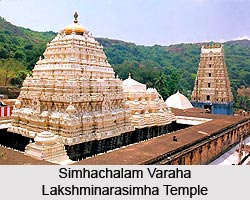
 Simhachalam Varaha Lakshminarasimha Temple is one of the ancient Hindu temples of Andhra Pradesh state of India. It is situated in the Visakhapatnam City suburb of Simhachalam in Andhra Pradesh. The temple enshrines Lord Narasimha who is the Incarnation of Vishnu. It was renovated by the Chalukyas in the 11th century and again by the Eastern Gangas in the 13th. The Tamil Cholas and Vijayanagar emperors patronized this temple.
Legends of Simhachalam Varaha Lakshminarasimha Temple
The Puranic legend states that Hiranyakasipu, in order to punish his son Prahlada threw him into the sea, and placed Simhachalam hill over his head in order to drown him. Lord Narayana as Narasimha rescued Prahlada, tilted the hill by standing on one side so that Prahlada could escape. Later, Prahlada founded this shrine. Lord Narayana incarnated as Lord Narasimha in order to kill Hiranyakasipu without violating the boons Shiva had granted him. After his death, his fury did not abate, and Lord Siva assumed the shape of a bird or Sarabha and pacified Lord Narasimha. The consecration of this image is said to destroy enemies, secures success in battles, cures ailments, and procures good.
The Sthalapurana consists of an account of the foundation of the temple. This temple was a favourite resort of the gods but fell into disuse. Urvashi, the divine Apsara, informed Pururavas that she had come to the Simhadri hill when Lord Narayana came as Narasimha in order to save Prahlada. Urvashi with Pururavas found the Gangadhara rivulet flowing west. Pururavas thought of finding the lord through penance. On the third day of meditation, he saw the Lord in his dream, who told Pururavas that an ant-hill in front of the king held the idol and the king should offer flowers, sandal wood, music, light lamps, and scented smoke to the Lord.
The king woke up, searched the ant-hill, found the idol, renovated the temple and consecrated it. But did not find the Lord`s feet. The lord spoke to the king that the feet will not be visible and are hidden in the earth, for their sight will get them salvation. And so he should not be seen in his pure form, but only as covered with sandal paste, except for one day on Akshaya Tritiya, where the mere sight was enough to bestow salvation.
Architecture of Simhachalam Varaha Lakshminarasimha Temple
Built on a hill, this temple has exquisitely carved halls. There is extensive use of both Chalukyan and Orissa architecture styles. The shrine is dedicated to Lord Narasimha. The temple is positioned 800 feet above sea level. A flight of steps goes all the way from the foot to the top of the hill, to the temple. At the foot of the hill there are choultries for the pilgrims to stay. They have a bath in the Pushkarani located close to the foothill. The way up is through a glen of trees, close to the top on the north side there is a wooded hollow surrounded by a wide circle resembling an amphitheater, this is the temple of Lord Narasimha of the Northern Circars.
 One of the pillars in the Mukhantantapa is named Kappam Stambham or the pillar of tribute. It attracts a large number of pilgrims. There is a popular belief that this pillar has the power to cure cattle disease, and barrenness in women. The deity is covered with a thick coating of sandal paste, which appeased the fury of the Lord after the destruction of Hiranyakasipu. This coating is removed only once a year, on the Visaka day in May. The temple comprises of a square shrine, with a tall gopura and mukhamantapa has a small circular tower over it. The natyamandapam has a stone car drawn by two horses, and is enclosed by a veranda, here scenes from the vishnupurana have been sculpted with great skill.
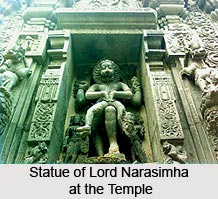
Outside the enclosure, to the north is the kalyanamantapam that has 96 exquisitely carved pillars where the Kalyana Utsava is performed on the eleventh day of the Suklapaksha, Chaitramasa every year. Here Lord Vishnu is represented as Matsya, Dhanvantri and Varuna. Here one will also find many murtis of Narasimha. A perennial spring called gangadhara is found here and is said to have medicinal properties. The Sthalapurana for the temple describes the temple in 32 chapters, and Vedavyasa wrote about the original temple in the Skanda Purana.
The inscriptions on the walls and pillars throw a light on the history of the temple. There is an inscription dated 1099 AD belonging to King Kulottungachola, who conquered Kalinga. Another belongs to the Velnati Chief, Gonka III and is dated 1137 AD, and states that he covered the image of the Lord with gold. There are a number of inscriptions from the Eastern Ganga kings of Kalinga. King Narasimha I constructed the central shrine, the Mukhamantapa, the Natyamantapa etc. The Reddy king of Rajahmundry, the Vishnu-Vardhana Chakravarthins of Panchadarla and others contributed thus enriching the temple. Krishandevaraya visited this temple twice in 1516 and 1519 AD and the jewellery offered by him to the Lord can still be seen here.
Festivals of Simhachalam Varaha Lakshminarasimha Temple
The Chandana Yatra festival is performed on the third day of the Sukla paksha of Visakha, which corresponds to Akshaya Tritiya day. On this day, the sandal paste is removed, and the devotees can have darshan of the lord. The Vyasa pournami and the Ashadha pournami days, and the Kalyanotsava in the first week of April are also important festivals.