 Santanu is the king of Hastinapura in the great epic of the Mahabharata. He is a descendant of the Bharata race, of the lunar dynasty and the ancestor of the Pandavas and the Kauravas. He was the third king after Bharata the great (who begin the lineage) and Dushyanta.
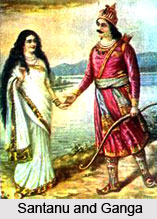
Santanu and Ganga
Once, while strolling on he banks of river Ganga Shantnu`s eyes set upon a beautiful damsel. Completely attracted by the damsel`s exceeding beauty, he asked the damsel whether she would marry him. The damsel agreed to his proposal but on the condition that the king would never question her about her actions. Santanu agreed to her condition and their marriage was solemnized.
Eventually, the lady gave birth to a baby, which she went and flung in the river Ganga. On seeing this the king was taken aback, however he did not ask her the reason bearing in mind the promise that he gave her before marriage. As time passed by, the lad gave birth to seven more children and flung them in the river every time they were born. When the eighth time she repeated the same action, the king got angry. Bewildered he asked her the reason for drowning the newborn babies. To this the lady replied that she was Ganga, the goddess of the river. Now that the king had broken his promise Ganga left him and went away. But before departing she promised that she would return their eighth child back to the king. Santanu was deeply saddened by Ganga`s departure and waited for years for his son.
After a few years as promised by Ganga, the child was returned to the king. The child was now a grown-up lad and was known by the name Devavrata better known as Bhishma, one of the central characters of Mahabharat.
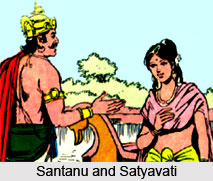
Santanu and Satyavati
When Bhishma grew up to be a handsome boy, Santanu fell in love with the daughter of a ferryman named Satyavati. The ferryman agreed to this marriage but on the condition that the children born to Satyavati would inherit the throne.
The king could not give his word, as Bhishma was the successor to the throne in real sense. On being informed about this, Bhishma magnanimously agreed to give the throne. He assured the ferryman that he shall renounce everything for the sake of his father`s happiness. So as to reassure the sceptical ferryman further, he also vowed life-long celibacy to ensure that future generation borne of Satyavati is also not challenged by his offspring. Shantanu and Satyavati went on to have two sons, Chitrangada and Vichitravirya.
After Santanu`s death, Satyavati continued to rule the kingdom with her two sons and with some help from Bhishma.
Chitraganda
 Chitrangada was the elder son of Shantanu and Satyavati. Since his elder half-brother Bhishma (son of Shantanu and Ganga) took a vow of not ascending the throne of Hastinapura, he became the king after Shantanu and was very successful. Unfortunately, his success angered a Gandharva king of the same name.
After fighting for three long years, Chitrangada was slained heirless. His younger brother Vichitravirya then ascended the throne.
Vichitvirya
Vichitravirya is the younger son of queen Satyavati and king Santanu. Chitrangada, the elder brother of Vichitravirya, succeeded Santanu to the throne of Hastinapura. When he died childless, Vichitravirya became the king.
As Vichitravirya was still a child when he was crowned king, Bhishma ruled as his regent. When the young king was of the marriageable age, Bhishma looked for a suitable bride. He heard the king of Kasi was holding a swayamvara for his three daughters. Since Vichitravirya himself was too young to stand any chance of being chosen by the young women, Bhishma himself went to the swayamvara.
Bhishma won the swayamvara and brought the Princesses Amba, Ambika and Ambalika to marry Vichitravirya. Since Amba had already given her heart to some other, Ambika and Ambalika were married to Vichitravirya.
Unfortunately, shortly after his marriage, Vichitravirya died of tuberculosis. As he died heirless, Vyasa was summoned to look after Pandu, Dhritarashtra and Vidura (who was the son of a maid and not of Ambika or Ambalika) who were left fatherless.