Operation Cactus was declared in November 1988. The People`s Liberation Front of Tamil Eelam (PLOTE) comprising about 200 Tamil secessionists invaded Maldives.At the request of the President of Maldives, Maumoon Abdul Gayoom. Indian Armed Forces launched a military campaign to fight the mercenaries out of Maldives.
Indian Navy and Operation Cactus
The key role, which the Indian Navy has come to play in the waters of the region, found flamboyant expression in Operation Cactus. The mission of the Indian armed forces was to deal with the armed force that sought to overthrow the democratically elected Government of the Maldives on 03 November 1988. Within hours of the cabinet decision to respond to President Abdul Gayoom`s appeal for military assistance, a marine investigation aircraft of the Navy was over the islands, while the Army and the Air Force were in the process of inducting troops to put down the attempted rebellion.
The landing of Indian troops forced the armed force to adopt a new strategy. They commandeered a merchant vessel, Progress Light, and taking with them a number of hostages, including the Maldivian Transport Minister and his wife, they set sail to Colombo. It was their intention to conduct negotiations in the glare of international publicity in Sri Lanka.
The Navy had diverted suitable ships to the Islands and the interception of Progress Light assumed supreme importance. A marine investigation aircraft spotted the merchant ship on the morning of 04 November, whereupon Indian Navy ships `Godavari` and `Betwa` sped to the scene to bring the rebels to book. It was a difficult mission, as the name implies. The safety of the hostages had to be the primary consideration at all times. A negotiating team sent by the Maldivian Government was embarked on `Godavari`, but it failed to work out an acceptable solution. The injured hostages were transferred to a hospital in Trivandrum, and the armed force was taken into custody aboard the Indian ships. The miscreants were handed over to the appropriate authorities. The effective combination of naval ships and aircraft and the mature handling of the situation defused a potentially volatile event.
Indian Airforce and Operation Cactus
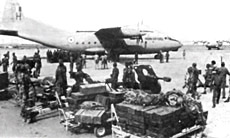 On the night of November 3, 1988, the Indian Air Force mounted special operations to airlift a parachute battalion group from Agra, non-stop over 2000 km. It was out beyond the Southwestern coast of India to the remote Indian Ocean archipelago of the Maldives. In response to that Government`s appeal for military help against a mercenary invasion, the IL-76s of No. 44 Squadron landed at Hulule at 00:30 hours, the Indian paratroopers securing the airfield and restoring Government rule at Male within hours. Buildup of forces continued the next day, with IL-76s, An-2s and An-32s flown to the Maldives from Trivandrum, while IAF Mirage 2000s made low level passes over the scattered islands in a show of force. The most immediate reality that emerged from this short, and bloodless, action was the speedy and effective Indian military response, made possible by the IAF`s strategic airlift capability.