Kunti was the mother of the eldest three sons of Pandu. She is regarded as a pious and loyal woman and is highly respected by everyone. In Shrimad Bhagvatam, Kunti has mentioned about Lord Krishna`s philosophies of devotion. Hence Kunti is held as a figure of great importance within many Hindu traditions and especially with worshippers of Krishna.
Kunti was the daughter of Surasena. As she belonged to the Yadu clan, she was the sister of Vasudeva, father of Krishna. Earlier Kunti was known by the name Pritha until she was given in adoption to King Kuntibhoja. After this, she was known by the name Kunti. After the arrival of Kunti, King Kuntibhoja was blessed with children. He considered Kunti his lucky charm and took care of her until the marriage.
Kunti`s boon
As a child she was given a boon by Rishi Durvasa. The boon was that by uttering the mantra, she could summon any deva and have a child by him without pregnancy. When Kunti asked why he gave her this mantra, he told her that it would be useful to her later in life.
Since Kunti did not believe in the mantra, she wished to give it a try. She uttered the mantra and God Surya appeared. She asked him to go back, but Surya said he was compelled to fulfill the mantra before returning. Kunti then abandoned the child in a basket in a river. This child was later found and adopted by a chariot driver and his wife, and was named Karna. He went on to become an important character in the Mahabharata.
Later on, Kunti married Prince Pandu of Hastinapura. He also had a second wife by the name Madri. Later on the three of them left the Hastinapura to live a life of hermit as Pandu was bestowed with a curse. The curse was that if Pandu ever tries to get intimate with his partner he shall die. Hence he could not father children.This was when Kunti remembered the boon that she was granted with long ago. She revealed this secret with Pandu and gave birth to three sons namely, Yudhisthir, Bheem, Arjuna. Pandu wished for more children, but as per the shastras a woman who gives birth to children without pregnancy, could have just three children. Hence to fulfill the wish of Pandu, she shared this mantra with Madri. Thus, Madri bore two children, namely Nakul and Sahadev.
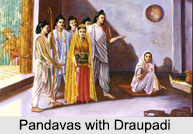
Once when Kunti was away with the five children, Pandu tried to get intimate with Madri. As a result Pandu died and out of growing guilt Madri too sacrificed her life. Now Kunti was left alone with the five sons. She returned back to Hastinapura with the children. She looked after the five children very well and made them into virtuous men.
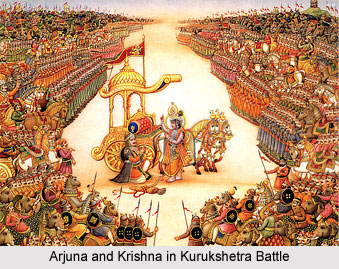
After the Kurukshetra battle, Kunti along with Dhritarashtra and Gandhari went to stay in the forest. She died along with others in a forest fire.