Indianetzone.com - Web Portal on Indian Culture & LifestyleArt & Culture  •  Health  •  Movies & Entertainment  •   Society  •  Reference  •   Sports  •  Travel  

  Home >> Society >> Indian Religion >> Indian Myths
Forum
Forum on Indian Religion
Discuss Now
Free E-magazine
Subscribe to Free E-Magazine on Indian Culture & Lifestyle.
Learn More
Interesting Readings
  - Baha`i Religion
  - Hinduism
  - Indian Yogis
  - Buddhism in India
  - Dharma Sastras
  - Goddesses of India
  - Gods of India
  - Indian Mythology
  - Indian Myths
  - Sikhism
  - Islam
  - Indian Religions
  - Indian Customs and Rituals
  - Vastu Shastra
Jimtrade.com : India Business to Business Directory
Business Directory of Indian Suppliers Manufacturers and Products from India.
India`s leading Yellow pages directory.
Indian Myths

People generally have doubts concerning myths. Only the historians can give us a genuine answer regarding the myths, whether it can be believed or not. The mythologists consider myths as colorful parts that form the beautiful assortment of people`s cosmology, which in itself is the totality of the world they live. This `cosmos` is different from the world, which we see. This does not mean that they do not see the same hills and rivers we see, but the hills and rivers they see are inhabited with their gods or spirits that we cannot see. The mythology of a people is actually an ordered collection of their myths. It is the description of the world with the past and future as they see it.

Religion is a part of mythology. Mythology tells us what people believe, as every religion is in itself based on beliefs or truths. The truths in religion cant be proved nor disproved. A scientist can never study `myths` as there is no clear evidence for it. What a sceptic regards as `mere` myth is `factual truth` for a believer as a result the sceptic will be outside the world of the believer. Then he or she will realize that every aspect of religion, including the rites, ceremonies, sermons, prayers, sayings and actions of the peoples daily life is based and dependent on mythology.

Indian Myths - Lord ShivaOne thing is sure; every kingdom has got its own religion. Though gods and ceremonies can be borrowed from the neighboring peoples or even families, gods belong to the clans who worshipped them. It is the duty of the worshippers to keep their gods alive, if the worshippers begin to worship newer gods the ancient gods or deities will be left to oblivion. Then the old gods will need sacrificial blood but the new gods only need prayers. Nobody knows how many Indian gods have died or have been forgotten. Only the names or altars of some ancient gods survive today.

The Indian People
It is generally believed that in 1500 BC all the people of India were living together peacefully and the merciless Aryans who invaded the country from the North destroyed this peace. Adolf Hitler can be blamed for calling Germans by the name `Aryans` and regarded with an air of pride that they were a naturally aggressive and domineering race. The French and English historians have written books blaming all the misfortunes their nations had to suffer on the Germans forgetting the fact that the French and the Saxons were also Germanic and therefore comes under the general title Indo-European.

Other races too invaded India one after the other. Some Dravidologists are of the view that the Dravidians once inhabited the major part of North- West India before the Aryans dislodged them. It also gives the fact that Dravidians may have invaded from the north. The Tibeto-Burmese people migrated from North China to occupy their present habitat. The scattered groups of people who are collectively called as Austro-Asiatic, and the Andamanians preceded them. The oldest surviving race is the Yedda or Weda people who inhabited the hills of Sri Lanka.

Aryans invaded India as a single organized body. The Aryans like their predecessors entered India in small clans in between 5000 and 3000 BC. They came from the West, which today is known by the name Iran.

Literature
RamayanWe do no know much about the chronology of early Indian history even though we have a wealth of linguistic material in Vedic, Sanskrit, Magadhi, Pali and Tamil. The origin of Tamil literature was in the first century BC. Vedic literature dates back to 1500 BC. It is the oldest Asian literature of a tradition. The Vedic hymns are still studied by the Brahmins. It is believed that the Sanskrit literature originated in 1200BC. The most renowned works of the post- Vedic period are the Upanishads and the Puranas. The most voluminous single work is the great epic Mababbarata. It is considered as the fountain of Indian mythology and contains over 200,000 lines. Another great work during this period is the Ramayana, which portrays the story of Rama, Sita and Hanuman and consists of 48,000 lines.

During the Middle Ages, large collections of long narrative songs were composed. The best known among them is the Katha-Sarit-Sagara, the Story River Ocean, which were authored by the poet Somadeva around 1000 AD. The famous prose collection of fables is the Pancha Tantra, Five Books of Wisdom, the Hitopadesha, the Shuka-Saptati (Seven Tales of a Parrot). In Pali literature, there was great interest in Jataka tales.

The Sources
The single great source for Indian mythology is Mahabharata, which is a vast storehouse of Indian culture, manners and morals. This great epic was the labor of many poets and editors, who created the structure of the Epic by arranging the various unrelated ballads (with different episodes) into 18 books of different sizes and contents. Other long passages have been composed in the early centuries of the Christian era. The oldest passages were composed in the language and meter of the later Vedic period. This great epic took more than a thousand year to be composed. The most famous philosophical insertion in the Bhagavad-Gita (5th century BC) is the Sermon of Krishna before the great battle. The Ramayana coincides with the later parts of the Mahabharata.

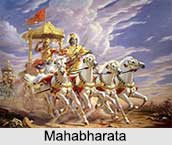
MahabharataMahabharata is considered as one of the greatest epics in the world literature not only because of its venerable antiquity or its enormous size but also because of the fact that entire life of India in Antiquity is in it and also there is the presence of nobility and humaneness. It is noble because its heroes had to obey an elaborate code of moral behavior. For example when the hero Bhima is unable to control his rage, his older brother Yudhisthira scolds him saying that such behaviour is unworthy for an Indian nobleman, and Bhima obeys his brother. It is the product of very humane authors as there is forgiveness in it, even for the very depraved characters. Not only warfare but also sport hunting and traveling is also described in detail. It also explains in detail religion and its sacrifices, liturgies, priests and ascetics. The forests, rivers and mountains of India are vividly described.

The Pandavas are the five noble heroes whose behavior is flawless contrasting with the dreadful dishonesty of Kauravas, their jealous cousins. The Mahabharata, is a textbook of ethics full of prominent moral lesson in them. It is a great romance too. It depicts the different emotions inherent in human beings as love, hatred, jealousy, revenge, forgiveness, faithfulness, treachery and a hundred other emotions as wellThere is understanding for the feelings of women and there is gentleness of attitude in the heroes representing that the Mababbarata was created in the country of non-violence, of Buddhism, Jainism and other noble philosophies. The Mababbarata contains much stuff of a genuine epic than the Ramayana. Mababbarata contains in it the struggle between Man and his destiny, between human beings and the immutable decree of the gods. The epic contains great scenes of bravery and human self-sacrifice. The Mahabharatha portrays the complete life of the characters whereas the Homeric epic describes only a brief period in the hero`s life. The Ramayana relates the happy episode in history when God walked upon earth to overpower the demons and release the people of the earth from the evil, which had accumulated at that time.

A student of mythology studies more than myths of epic tales. The reality of one community is a fairy-tale world for others. The Indian philosophers are well aware of this and they call it `Maya` or illusion. .

The world we live in, the gods we think we have seen, are all images in our minds. The truth is that human eyes cannot see the essence of reality. This concept gives Indian myths a lightheartedness, which the myths of other nations lack.

History
India`s history when summarized is a list of dynasties with a few emperors who ruled at different times at different capitals. Each dynasty is renowned for its distinctive art, architecture, sculptures and paintings. In India there are places, which are noted as being the spots of seven most ancient capital cities of India.
Hastinapura on the River Ganges is now a small village but during the Epic times, was the capital of a kingdom. Indraprastha was believed to be underneath the present New Delhi. Ujjain, Ujjaina in the Vindhya district still has ample ruins. Kapilavastu, which is in the North, was once the kingdom of Buddha`s father. Ayodhya, near Oudh was once Rama`s capital. Kosala was the capital of the extensive kingdom of Shravasti, who was the founder of Shaishunaga dynasty. His descendent, King Bimbisara has been a benefactor of the Buddhist monks and their monasteries. His contemporary, Darius I of Persia, stretched his empire to the Indus Valley and had sent an armada to India, which appeared to be the first navy in history. Until Alexander the Great arrived, the Indus remained as the border between India and Persia. Ajatashatru succeeded his father Bimbisara during the 494-467 BC. He built the fortress of Patali, which was later developed into the majestic city of Pataliputra. Later he conquered the kingdom of Kosala. His son, Darshaka succeeded Ajatashatru during the 467- 443 BC. His son Udaya again succeeded him.

It was the Persians who first brought the Aramaeic alphabet. In India, it was developed into the Kharoshti alphabet, which became the mother of all Indian alphabets till date. The only exemption is the Arabo-Persian system of writing, which came to India with Islam. The Kharoshti alphabet spread beyond India to China. The early alphabet of the Buddhists of Turkestan was based on this script. Buddhism brought Indian scripts to South-East Asia. King Bimbisara was related to Vardhamana Mahavira and his son Ajatashatru had visited Buddha in 450 BC. The rise of the two philosophies, Buddhism and Jainism, was due to the Brahmins overemphasis on ritual, which further led to elaborate ceremonies dominated by priests who had to be full-blooded Bhramins.

Buddhism and Jainism gained popularity among the Kshatriyas until the assault of the Turkish-Muslim invasions that shattered the foundation of the old Hindu society and as a result Hinduism was reduced as a religion of the peasants (poor people). Remarkably, the priestly class survived and when the British conquered India in the 19C, in turn, destroying the Muslims, Hinduism once again revived to glory and thus became the oldest religion of India. It also claims credit as the oldest surviving Indo-European religion. The Hindus were more scholarly than the Muslims and as a result the spiritual leaders of India gave Hinduism a modern outlook.

It would be difficult to explain what these new Indian scholars adapted from Western thought and what they took and restored from ancient Hindu cosmology. The process is going on till date as the Western ideas put much `mental pressure` on the minds of Indians as it took much time for them to adapt to the age of science, technology and mathematics.

Hinduism is by nature a multiple cosmology without a fixed monolithic code of belief like Islam. In Hinduism there is room for exchange of views while Buddhism regards all our views as illusion.

Hinduism and Buddhism survived till date because they are flexible philosophies, and so, like Christianity, they are open to debate and evolution. Islam on the other hand prefers to return to the oldest forms and doctrines.

Recently updated articles in Indian Religion
Home | Sitemap | Contact Us