


 The Jammu and Kashmir state has a rich heritage with respect to art and craft. Tours to Kashmir give the tourists the chance to explore the artistic tradition of the different tribes who make different parts of this colourful region their home. Each of these tribes has their own tradition and culture which is still reflected in their day-to-day items like clothes, utensils etc. The Jammu and Kashmir state has a rich heritage with respect to art and craft. Tours to Kashmir give the tourists the chance to explore the artistic tradition of the different tribes who make different parts of this colourful region their home. Each of these tribes has their own tradition and culture which is still reflected in their day-to-day items like clothes, utensils etc.
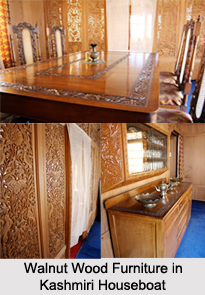
Kashmiri Handicrafts are prized possessions all over the world for their exquisite craftsmanship. The designs and Naqqashi work done on the various handcrafted items have a strong imprint of ancient tradition. Kashmiri artisans endeavour to carry on the ancient tradition of artistry, though a few changes have taken place. The remote rural regions in Kashmir provide the spectacle of these artisans at work, creating exquisite works of art. Kashmiri woodwork is very popular. Extensive carving is done on wooden furniture, wooden boxes and other decorative and useful items made of wood. The wood crafts also include intricately carved walnut wood furniture and accessories. Even Kashmiri Papier Mache work is quite popular, with items ranging from vases to bowls, jewellery boxes to mirror frames and other decorative items having exquisite traditional designs with vibrant colours on them. Stone jewellery boxes and hand woven willow baskets are also exquisite crafts of Kashmir, and the locals utilise these in their everyday use. The capital city Srinagar is lined with rows of shops filled with handicrafts on its streets. The array of products displayed is very appealing and suits every pocket, given the variety within each craft is wide. Wood Crafts of Kashmir Woodcrafts in Kashmir are mostly associated with the architecture of the place. Carving skills in the region were ancient, but shifted from stone to wood during the Muslim Sultanate period in the 14th century and so did the aesthetics, from figurative to geometric. The Pinjrakaari and Khatambandi crafts of decorative lattice and panelling came much earlier with Turkish and Persian influences. The famed Kashmiri wood craft and wood carving rests on the use of Walnut Wood as raw material. The walnut plants grow at altitudes from 5,500 to 7,500 feet above the sea level. Due to its durability and natural colour, it is regarded as most suitable for both carving and wood work. The carving is done skilfully and in variety where it is deep, not deep, see through and undercut, with indigenous tools. Houseboats and carved walnut furniture, with intricately carved floral, chinar and animal motifs emerged during the Sikh and Dogra periods, catering to the influx of European tourists to Kashmir throughout the 19th and 20th centuries. Walnut wood carving workshops exhibit different styles of carving, particularly the undercut style that involves carving up to several layers in a single panel. Beautiful grains of walnut wood and simple dedication of these internationally recognised master craftsmen are highly exquisite. 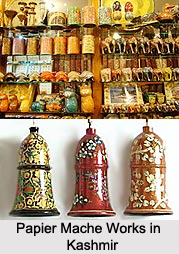
Papier Mache Products of Kashmir Master Craftsmen of Kashmir were acclaimed for their artistry in making Qalamdaans, a craft introduced by the Persians using gold, mineral dyes and homemade brushes of single strand of cat’s hair. Remnants of this craft are still visible in the relaxing chambers of the emperors at the Shalimar Bagh, a Mughal garden in Srinagar. In recent times, this fine miniature style of hand painting by the Naqqash is called Papier Mache, still a collector’s prized possession. At first glance, all Papier Mache products look roughly the same, and the price differential seems almost unreasonable. However, besides at least three different grades of Papier Mache, some is actually cardboard or wood. The idea, however, is not to hoodwink the unwary, but to provide a cheaper product for someone who wants the look of Papier Mache. To make Papier Mache, first paper is soaked in water till it disintegrates. It is then pounded, mixed with an adhesive solution, shaped over moulds, and allowed to dry and set before being painted and varnished. Paper that has been pounded to pulp has the smoothest finish in the final product. When the pounding has not been thorough, the finish is less smooth. The designs painted on the objects of Papier Mache are brightly coloured. They vary in artistry and colour choice, and it is not difficult to tell a mediocre piece from an excellent one. Gold is used on most objects, either as the only colour or as the highlight for certain motifs, and besides the finish of the product, it is the quality of gold used that determines the price. Pure Gold leaf, which has the unmistakable lustre, is far more expensive than bronze dust or gold poster paint. It has a much longer life and will never fade or tarnish. Varnish that is applied to the finished product, imparts a high gloss and smoothness, which increases with every coat. Cardboard is usually indistinguishable from Papier Mache and the only difference is in the price, the former of course being cheaper than the latter. Willow Wickerwork of Kashmir A Kashmiri version similar to cane basket making, willow wickerwork comprises furniture and other items made of an indigenous grass called willow, which has a natural finish. Willow rushes that grow plentifully in marshes and lakes in Kashmir are used to make charmingly quaint objects, ranging from shopping baskets and lampshades to tables and chairs, all generally falling expensive. To increase their life span, unvarnished products should be chosen and frequently sprayed with water, particularly in hot and dry climates, to prevent them from becoming brittle. Willow clusters are found mostly in Ganderbal, but the basket makers near Hazratbal provide a mesmerising experience. Pottery of Kashmir 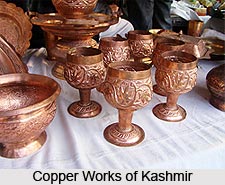 Dalgate Pottery, named due to it being sold around the Dalgate area of Srinagar, is practised by the potters in Rainawari and Khaniyar. Known for their Chinese-Persian influenced colourful glazed tiles, martbans, dodhpyal, hukkahs and tourist souvenirs, the craft is now being revived with the support of the heritage conservation wing of the Jammu & Kashmir Bank. Dalgate Pottery, named due to it being sold around the Dalgate area of Srinagar, is practised by the potters in Rainawari and Khaniyar. Known for their Chinese-Persian influenced colourful glazed tiles, martbans, dodhpyal, hukkahs and tourist souvenirs, the craft is now being revived with the support of the heritage conservation wing of the Jammu & Kashmir Bank.
Copperware and Silverware of Kashmir Among silver filigree, bronze firearms and enamelled metal ware, it is the copper engraving that still flourishes in Kashmir due to the local demand and customs. Delicately beaten and engraved copper utensils are a common sight in homes and weddings, the traditional samovar being indispensable for serving tea. Hazratbal, Zaina Kadal and Khaniyar areas are the pockets of copper beaters and fine engravers. The old city too abounds with shops where objects of copper line the walls, floors and even ceilings, made generally for the local market. Craftsmen can often be seen engraving items of household utility such as samovars, bowls, plates and trays. Floral, stylized, geometric, leaf and sometimes calligraphic motifs are engraved or embossed on copper, and occasionally silver, to cover the entire surface with intricate designs which are then oxidized, the better standing out from the background. The ‘naqash’ work on these crafts determines the price of the object, as does the weight. Related Articles: Jammu and Kashmir Walnut Wood of Kashmir Art of Kashmir Crafts of Jammu and Kashmir Tribes of Kashmir Papier Mache Srinagar Wood Carving, Indian Tribal Art Kashmir |
| |||



Home > Art & Culture > Indian Crafts > Crafts of Indian States > Crafts of Jammu and Kashmir > Material Crafts of Kashmir
Material Crafts of Kashmir
| The material crafts representing the diverse culture of Jammu & Kashmir, encompass woodcrafts, papier mache products, copper and silver works, pottery and basketry. |
| ||||||||||||||||||||||||||||

