





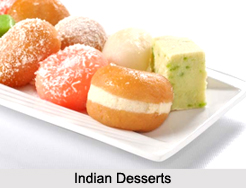
 Indian Desserts are a perfect delight in every season which not only satisfies the taste buds but also energizes the body with glucose shots. India has a wide range of very delectable, finger licking and luscious Indian desserts recipes. Indian sweet seems difficult to resist. It is said that there is no country has a wider range of exotic, luscious sweets than in India. A sumptuous meal is always incomplete without sweet dish like ‘Gulab Jamun’ or ‘Kulfi’ or ‘Gajar ka Halwa’. Desserts give a befitting end to any meal. Indian Desserts are a perfect delight in every season which not only satisfies the taste buds but also energizes the body with glucose shots. India has a wide range of very delectable, finger licking and luscious Indian desserts recipes. Indian sweet seems difficult to resist. It is said that there is no country has a wider range of exotic, luscious sweets than in India. A sumptuous meal is always incomplete without sweet dish like ‘Gulab Jamun’ or ‘Kulfi’ or ‘Gajar ka Halwa’. Desserts give a befitting end to any meal.
History of Indian Desserts Historical facts lay bare that, desserts in India have an influence of various cultures those have come to India over the years through invasions or as a visitor. The word ‘Dessert’ has its etymological roots in the French term that has been derived from the word ‘desservir’ which means "to clear the table" or "to serve". The origin of sweets in India has been traced to at least 500 BC, where both raw sugar as well as refined sugar was being produced. 
Types of Indian Desserts Indian Desserts can be divided into 2 broad categories one major category is the milk based dessert such as ‘Rabri’, ‘Peda’, ‘Barfi’ and so on. The second category of Indian dessert includes flour based sweets such as ‘Lal Mohan’, ‘Malpoa’, ‘Halwa’ and ‘Ladoo’. Popular Indian deserts, such as, ‘Rassagolla’ is generally a marked fetish of the Bengalis. ‘Kulfi’, ‘Gajar ka Halwa’, ‘Kheer’, ‘Shrikhand’, ‘Ras Malai’, ‘Gulab Jamun’ and ‘Barfi’ are some of the India Desserts that are well-liked in an Indian table. Most of the desserts have originated as local favourites and are synonymous to only an ethnic group in the country. Regional Indian Desserts Every state has its own traditional signature sweet dish that is prepared during festivities or religious rituals. In the northern part of India, milk is the staple and most of the sweets are based on milk products while in southern part of India, coconut milk is widely used in making of sweets along with milk. The eastern part of the country is renowned for the date palms called ‘Nolen Gur’ that is used to create desserts such as ‘Sandesh’, dense bites of sweetened cheese. The popularity of desserts served and prepared in India has gained popularity throughout the world. Every celebration in India is unfair without the servings of sweets and desserts. Indian desserts are an important part of not only Indian cuisine but Indian culture as well. |
| ||||||||||||||||||||||||||||

