


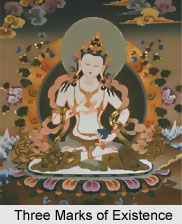
 According to the Buddhist tradition, all observable facts other than Nirvana, are marked by three characteristics, at times referred to as the Dharma seals, i.e., anicca (impermanence), dukkha (suffering), and anatta (non-self). According to tradition, after a good deal of meditation, the Buddha came to the conclusion that everything in the physical world (including everything in the phenomenology of psychology) is marked by these three chatacteristics: According to the Buddhist tradition, all observable facts other than Nirvana, are marked by three characteristics, at times referred to as the Dharma seals, i.e., anicca (impermanence), dukkha (suffering), and anatta (non-self). According to tradition, after a good deal of meditation, the Buddha came to the conclusion that everything in the physical world (including everything in the phenomenology of psychology) is marked by these three chatacteristics:
Anicca (Sanskrit anitya) or impermanence. This refers not only to the fact that every conditioned thing eventually ceases to exist, but also that every conditioned thing is in a constant state of change. ( As an example, oen can visualise a leaf growing to a tree. It dies and falls off the tree, but is soon replaced by a new leaf). Dukkha (Sanskrit duhkha) or unsatisfactoriness, 'disease' (often translated as "suffering," though this is slightly misinforming). Nothing found in the physical world or even the psychological territory can bring persistent, intense satisfaction. Anatta (Sanskrit anatman) impersonality, or non-Self. The human personality, "soul", or self, is a conventional appellative applied to the assembly of physical and psychological components, each separately subject to constant change; there is no central core (or essence); this is more or less similar to a bundle theory (originated by the 18th century Scottish philosopher David Hume, this is the ontological theory about objecthood in which an object consists only of a collection (bundle) of properties, relations, or tropes) of mind or soul. There is often a fourth Dharma Seal mentioned: Nirvana is peace. Nirvana is the 'other shore' from Samsara (a Sanskrit or Pali term, it signifies a 'continuous movement' or 'continuous flowing', referring to the cycle of birth and consequent decay and death, in which all beings in the universe participate and which can only be escaped through enlightenment). Together the three characteristics of existence are called ti-lakkhana, in Pali; or tri-laksana, in Sanskrit. By bringing the three (or four) seals into a 'moment-to-moment' experience through concentrated awareness, one is believed to achieve Wisdom - the third of the three higher trainings - the way out of Samsara. In this manner, one can identify that, according to Sutra, the recipe (or formula) for departing Samsara is accomplished by a deep-rooted change to one's world view. |
| |||



Three Marks of Existence
| Buddhist philosophy speaks of three fundemental characteristics of the discernible world, pertaining to humanity. |
| ||||||||||||||||||||||||||||

