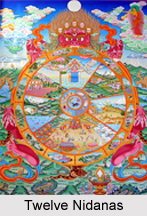
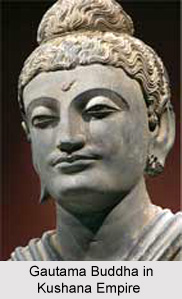
 Buddhist symbolism appeared from about the 3rd century BCE, and started with unearthly symbolism, averting direct representations of the Buddha. Anthropomorphic symbolism appeared from about 1st century CE, with the arts of Mathura and the Greco-Buddhist art of Gandhara, and were blended with the previous symbols. Innumerable symbolic innovations were introduced later, particularly through Tibetan Buddhism.
The early aniconic symbols
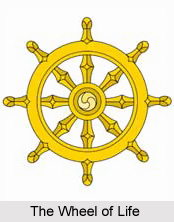
Among the earliest and most common symbols of Buddhism are the stupa, Dharma wheel, and the lotus flower. The dharma wheel, traditionally represented with eight spokes, can carry a motley of meanings. It initially only stood for royalty (concept of the "Monarch of the Wheel", or
 Chakravatin), but started to be used in a Buddhist context on the Pillars of Ashoka during the 3rd century BCE. The Dharma wheel is largely seen as referring to the historical process of instructing the buddhadharma; the eight spokes associate themselves with the Noble Eightfold Path. The lotus, as well, can carry several meanings, often referring to the intrinsically pure potential of the mind.
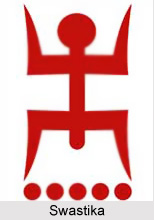
The swastika was traditionally used in India by Buddhists and Hindus as a sign of good fortune. In East Asia, the swastika is often used as a general symbol of Buddhism. Swastikas used in this context can be both left or right-facing.
Other early aniconic symbols include the trisula, a symbol used since about the 2nd century BCE that combine the lotus, the vajra diamond rod and a symbolisation of the triple gems (The Buddha, the dharma, the sangha).
The first trace of a human representation in Buddhist symbolism appear with the Buddha footprint.
Although the Buddha was not represented in human form until around the 1st century CE, the physical charactetistics of the Buddha are described in one of the cardinal texts of the traditional Pali Canon - the Digha Nikaya, in the discourse titled "Sutra of the Marks" (Pali: Lakkhana Sutta) (D.iii.142ff.).
These characteristics consist of 32 signs, "The 32 signs of a Great Man" (Pali: Lakkhana Mahapurisa 32), and were appended by another 80 Secondary Characteristics (Pali: Anubyanjana). These traits are believed to have outlined the appearance of the historical Buddha, Siddhartha Gautama and have been used symbolically in many of his representations.
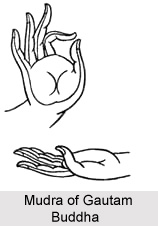 Mudras in Buddhist symbolism, Buddhism
Mudras are hand-held gestures that symbolise one or the other abstract forms of teachings or feelings. The Mudras are a series of symbolic or ritualistic hand gestures, describing the actions of the characters represented in only the most interesting Buddhist art.
Eight auspicious symbols, Buddhism
Buddhists make use of a set of eight symbols in every kind of art, considered hugely promising. Mahayana and Vajrayana Buddhist art frequently makes use of a particular set of eight auspicious symbols, ashtamangala, in household and public art. These symbols have spread with Buddhism to many cultures and arts, including Indian, Tibetan, Nepalese, and Chinese art.