 Rebirth in Buddhism is the doctrine that the consciousness of a person (as regarded conventionally), upon the death or disintegration of the aggregates (skandhas) which constitute that person, becomes one of the contributing causes for the developing of a new group of skandhas which may again be conventionally conceived as a person or individual. The consciousness developing in the new person is neither identical to, nor different from, the old consciousness, but forms part of a causal continuum or flow with it. The fundamental cause for this relentless re-arising of personality is the residing of consciousness in avijja (ignorance); when ignorance is exterminated, rebirth ceases.
Although the cessation of a life is not in itself a sufficient condition for the commencement of a new life (since arhats, pratyekabuddhas and buddhas pass away without rebirth), the backing conditions for a new birth are almost always present. From an external point of view, each life seems as a link in a beginningless succession of lives, varying in length and quality.
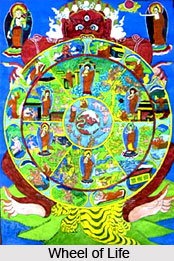
In traditional Buddhist cosmology, these lives can be in any of a large number of states of being, including those of humans, any kind of animal, and several types of supernatural being. The kind of rebirth that arises at the end of one life is conditioned by the karmas (actions of body, speech and mind) of previous lives; good karmas will generate a happier rebirth, bad karmas will produce one which is unhappier.
In the traditional Buddhist languages of Pali and Sanskrit, there is no word corresponding exactly to the English "rebirth". A rebirth, i.e., the state one is born into, is referred to as jati, i.e. simply "birth", also referring to the procedure of being born or coming into the world in any means. The entire process of change from one life to the next is called punarbhava (Sanskrit) or punabbhava (Pli), literally "becoming again"; it is also known just as bhava, i.e. "becoming". The process seen from a universal perspective, embracing all living beings, is called samsara.
From an interior point of view, a person who remembers or imagines a past life is prone to think of it as symbolising a continuity of existence between lifespans, i.e., that the same person was formerly one person (with a certain name and body) and is now a different person (with another name and body). This perspective is disagreeable from the point of view of Buddhist philosophy on two counts. First, because it seems to involve an enduring, self-existing entity that exists disunited from the elements of mind and body, contrary to the Buddhist philosophical position of anatman. Second, because it neglects the characterisation of this process as one of ceaseless change, both within and between lives, in which the newly-arising life is conditioned by, but in no respect identical to the pre-decedent life.