|
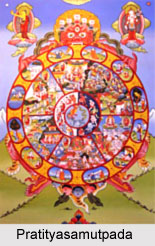 The doctrine of pratatyasamutpada (Sanskrit; Pali: paticcasamuppada), often interpreted as "Dependent Arising," is a significant part of Buddhist metaphysics. Common to all schools of Buddhism, it states that phenomena arise together in a mutually interdependent network of cause and effect. It is variously depicted into English as "dependent origination", "conditioned genesis", "dependent co-arising", "interdependent arising", or "contingency". The coming into being of life which is suffering, as well as its cessation, is explained by the doctrine of Pratityasamutpada. From ignorance springs the samskaras (conformations), from the samskaras springs consiousness, from consciousness spring name and form, from name and form spring the six provinces (of the six senses, eye, ear, nose, tongue body or touch and mind), from the six provinces springs contact, from contact springs sensation, from sensation springs thirst (or desire), from thirst springs attachment, from attachment springs becoming, from becoming springs birth, from birth spring old age and death, grief, lamentation, suffering, dejection and despair. Such is the origin of this whole mass of suffering. The doctrine of pratatyasamutpada (Sanskrit; Pali: paticcasamuppada), often interpreted as "Dependent Arising," is a significant part of Buddhist metaphysics. Common to all schools of Buddhism, it states that phenomena arise together in a mutually interdependent network of cause and effect. It is variously depicted into English as "dependent origination", "conditioned genesis", "dependent co-arising", "interdependent arising", or "contingency". The coming into being of life which is suffering, as well as its cessation, is explained by the doctrine of Pratityasamutpada. From ignorance springs the samskaras (conformations), from the samskaras springs consiousness, from consciousness spring name and form, from name and form spring the six provinces (of the six senses, eye, ear, nose, tongue body or touch and mind), from the six provinces springs contact, from contact springs sensation, from sensation springs thirst (or desire), from thirst springs attachment, from attachment springs becoming, from becoming springs birth, from birth spring old age and death, grief, lamentation, suffering, dejection and despair. Such is the origin of this whole mass of suffering.
Again, by the destruction of ignorance, which consists in the complete absence of lust, the samskaras are destroyed; by the destruction of the samskaras, consciousness is destroyed; by the destruction of consciousness, name and form are destroyed; by the destruction of name and form, the six provinces are destroyed; by the destruction of the six provinces, contact is destroyed; by the destrcution of contact, sensation is destroyed; by the destruction of sensation, thirst is destroyed; by the destruction of thirst, attachment is destroyed; by the destruction of attachment, becoming is destroyed; by the destruction of becoming, birth is destroyed, by the destruction of birth, old age and death, grief, lamentation, suffering, dejection and despair are destroyed. Such is the cessation of this whole mass of suffering in Pratityasamutpada. It is based on the truths that man is bound to the wheel of life, and it is possible for him to release himself from these bonds by arresting the transitive character of causation. A view similar to this theory of the wheel of causation is suggested in the Upanishads. The wheel of causation is at times distinguished into elements derived from the past life, those from the present and those of the future.
|





