Morality and Ethics in Jain philosophy - Informative & researched article on Morality and Ethics in Jain philosophy
  Indianetzone: Largest Free Encyclopedia of India with thousand of articles Indian Philosophy


in  
Art & Culture | Entertainment | Health | Reference | Sports | Society | Travel
Forum  | Free E-magazine
Indian Philosophy : Indian Philosophy l Schools of Indian Philosophy l Classical Indian Philosophy l Indian Religious Philosophy l Buddhist Philosophy l Upanishads l Indian Philosophers l Atomic Theories l Hindu Philosophy
Home > Reference > Indian Philosophy > Schools of Indian Philosophy > Jain Philosophy > Morality and Ethics in Jain philosophy
Morality and Ethics in Jain philosophy
Jains follow a fivefold path of morality and ethical purity, by which one can reach moksha.

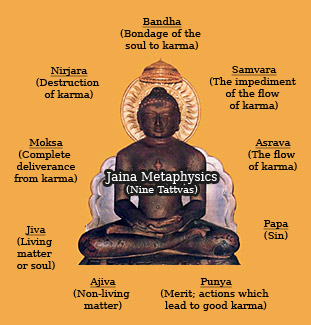
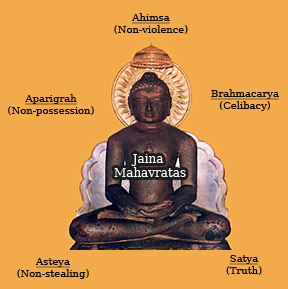
Jain Mahavratas - Morality and Ethics in Jain philosophy capsuled in the mahavratasThe Jain morality and ethics are embedded in its metaphysics and its usefulness towards the soteriological objective of liberation. Jaina ethics germinated out of the rules for the ascetics which are capsuled in the mahavratas or the five great vows:

Ahimsa, non-violence
Aparigrah, non-possession
Asteya, non-stealing
Satya, truth
Brahmacarya, celibacy

The ethics are administered not only through the instrumentality of physical actions, but also through oral action and thoughts. Hence, ahimsa has to be observed through mind, speech and body. The other rules of the ascetics and laity are deduced from these five key vows. Jainism does not call forth the fear of God as an explanation for moral behaviour. Observance of the moral code is not necessary merely because it is a commandment of a God or any other Supreme Being. Neither, is its observance necessary just because it is conducive to general welfare of the state or the community. While it is true that in Jainism moral and religious injunctions were established as law by Arhats, who have achieved perfection through their supreme moral efforts, their obedience is just not to please a God. It is because the life of the Arhats has presented that such commandments were conducive to Arhat`s own welfare, helping him to attain spiritual victory. Just as Arhats achieved moksha or liberation by observing the moral code, so can anyone, who abides by this path.

(Last Updated on : 23/04/2011)
  More Articles in Jain Philosophy
 
Constituents of reality in Jain philosophy Metaphysics in Jain philosophy Milestones towards moksha, Jain philosophy
Morality and Ethics in Jain philosophy Nature of Divinity and God in Jain philosophy Path to Salvation in Jain Philosophy
Jain Symbols Social Utility of the Jaina Karmic Theory Classification of Karma
Karma In Jain Philosophy Dissociation of karma Cause of karmic bondage
Nirvana Pushpadanta Pushpottara
Dravyas or Substances in Jain Philosophy Pudgala Basic Truths of Jain Philosophy
Body Functions Reform Movement of the Jains Action of the soul
Conduct of Life Types of Soul Conditions of Soul
Concept of Suffering Fourteen Gunasthanas Jain Cosmology
Anekanta Vada Syadvada Nayavada
Nigrantha Movement    
Recently Updated Articles in Indian Philosophy
  • Suhrawardi Order
    Suhrawardi Order, founded by Shihab-ud-din Suhrawardi, is considered one of the most prominent principles of Sufism.
  •  
  • Naqshbandi Order
    Naqshbandi Order is a notable Sufi order that originated during the reign of Akbar in India.
  •  
     
  • Hakim Sanai
    Hakim Sanai is considered to be the earliest Afghan teacher to use the love-motif in Sufism.
  •  
  • Sufi Philosophy
    Sufism is the philosophy that traces back to the Prophet Mohammad with a copious tradition.
  •  
  • Satya
    Satya means truth and is the quality of goodness, purity, knowledge and quiescence.
  •  
    E-mail this Article | Post a Comment
    RSS Feeds
    Forum
    Forum on Indian Philosophy

    Free E-magazine
    Subscribe to Free
    E-Magazine on Indian Crafts
     
     
    Morality and Ethics in Jain philosophy - Informative & researched article on Morality and Ethics in Jain philosophy
    Sitemap
    Contact Us   |   RSS Feeds
    Copyright © 2008 Jupiter Infomedia Pvt. Ltd. All rights reserved including the right to reproduce the contents in whole or in part in any form or medium without the express written permission of Jupiter Infomedia Pvt. Ltd.