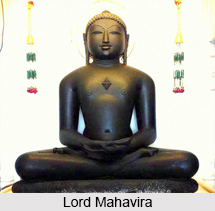
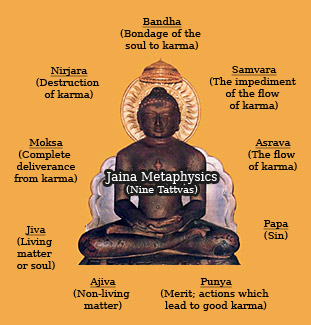
 Jain metaphysics asserts the existence of principle of sentient or consciousness, called as Jiva or soul, characterised by knowledge and perception. There are infinite, independent souls categorised into: liberated and non-liberated. Infinite knowledge, perception and bliss are the inherent qualities of a soul. These qualities are completely enjoyed uninterrupted by liberated souls, but clouded by karmas in the case of non-liberated souls, resulting in karmic bondage. This bondage further results in a continuous co-habitation of the soul with the body. Thus, an embodied non-liberated soul is found in four territories of existence - heavens, hells, humans and animal world - in an un-ending cycle of births and deaths, also known as samsara. The soul is in bondage since time immemorial; however, it is possible to attain liberation through rational perception, rational knowledge and rational conduct.
According to Jaina metaphysics, the soul is the master of its own destiny. One of the qualities of the soul is total lordship of its own destiny. The soul alone selects its actions and soul alone reaps its consequences. No god, prophet or angel can intervene in the actions or the destiny of the soul. Moreover, it is the soul alone who makes the required efforts to attain liberation without any godly grace. Amongst the twelve contemplations (anupreks?s) of Jains, one of them is the loneliness of one`s soul and nature of the Universe and reincarnation. Thus, only by purifying one`s soul by one`s own actions can one help oneself.
Jain metaphysics is also based on seven (sometimes nine, with sub-categories) truths or fundamental principles, also known as tattva, which are an effort to explain the nature and solution of human plight. The first two are the two ontological categories of the soul and the non-soul, namely the axiom that they exist. The third truth is that through interaction, called yoga, between the two substances, soul and non-soul, karmic matter flows into the soul ?srava, adheres to it, becomes converted into karma and the fourth truth acts as a factor of bondage bandha, restraining the manifestation of the consciousness inherent to it. The fifth truth states that an arrest (samvara) of new karma is possible through austerity, through practice of right conduct, faith and knowledge. An intensification of austerity burns up the existing karma - this sixth truth is conveyed by the word nirjar?. The final truth is that, when the soul is released from the influence of karma, it reaches the goal of Jaina teaching, which is liberation or moksha. Some authors add two additional categories: the meritorious and demeritorious acts, related to karma (punya and p?pa). These nine categories of primal truth, called navatattva, form the basis of entire Jain metaphysics.