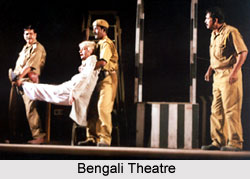
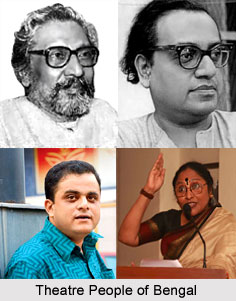
 Khaled Choudhury, born in the year of 1919, is one of popular theatre personalities of Bengal who was engaged in designing sets. He worked for different Bengali theatre directors and also in Hindi plays. Some of the names he worked with in various capacities are Shambhu Mitra, Tripti Mitra, and Shyamanand Jalan. He indulged in creating the stage - sets and costumes and later he worked as a Music Director as well. He is a bachelor, and presently resides in Kolkata. He has been awarded the Padma Bhushan for his contribution to theatre in Indian Republic Day Honours List on 26th January, 2012.
Biography of Khaled Choudhury
In 1945, he joined Indian Peoples Theatre Association but his first break came by accident when Sombhu Mitra asked him to design and make the set for Rabindranath Tagore`s Raktakarabi i.e. `Red Oleander` staged by Bohurupee in 1954. He was an adept painter, sketcher, and musician, who also devised special musical instruments for Raktakarabi. Since then, he has imaginatively designed and supervised construction for over fifty productions by leading Kolkata groups. The list also included some of Bohurupee`s historic interpretations of Tagore and Badal Sircar.
He was unacquainted with mainstream Bengali theatre when he designed Raktakarabi. He turned this very lack into an advantage. Viewing sets and props not as static objects for functional or decorative purposes, he conceived them in their totality as integral parts of the play. In I960 he wrote, "Stage design can never be an art in itself.... The elements of stage design are static while everything else in the play is dynamic. Therefore the endeavour should be to give the stage props a quality that would create the impression of dynamism related to the movements of the actors. The director, the stage designer and lighting designer have to work closely together to make the stage design an organic part of the performance". Khaled Choudhury worked steadfastly on his ideas. He succeeded to a large extent in imparting this dynamic dimension to space rather than just providing a setting. His concept of decor is similar to the views of Brecht and his stage designer Caspar Neher. For Raktakarabi he designed a set with multi-level linear compositions and a colour scheme to emphasize the soul-destroying rigidity and hierarchical nature of society in the play. He brought about a near-total change in the attitude to sets of contemporary Bengali theatre. While he seemed to have lost interest in scenography during the 1970s, shifting to folk music and folklore research, his association with theatre partially revived afterwards.