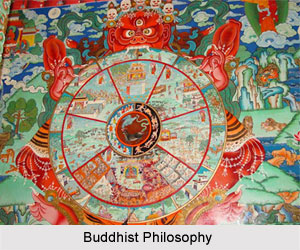
 Karma in Buddhist Philosophy means whatever one does, say or thinks. Karma implies `action` or `doing`. In Buddhism, the term karma is used specifically for those actions which spring from mental intent and mental obsessions, which bring about a fruit (Pali, phala) or result (vipaka), either in the present life, or in the setting of a future rebirth. Karma is the engine which drives the wheel of the cycle of uncontrolled rebirth (samsara) for each being. According to Buddhist Philosophy, through divine service or karma one can also reach the highest. Karma is act or deed, even that by which the impersonal becomes personal. Karma is said to be beginning-less, and the exact manner by which the work of the world proceeds is hard to understand. Since the world process is dependent upon the Lord, He is also known as the lord of karma. Every person is committed to some action or the other. It is necessary that the conduct of human beings promotes the interests of righteousness, which at the same time results in spiritual rest and satisfaction. Karma Marga is the path of conduct by which the individual thirsting for service can reach the goal.
In the (Anguttara Nikaya Nibbedhika Sutta) Lord Buddha said, "Intention (chetana), monks, is karma, I say. Having will one acts through body, speech and mind."
Every time a person acts, there is some character of intent at the bottom of the mind and it is that quality rather than the outward appearance of the action that determines the effect. If a person professes pious ness and virtue but still acts with greed, anger or hatred (veiled behind an outward display of well-meaning intent) then the fruit of those actions will bear proof to the underlying intention that lay behind them and will be a cause for future unhappiness. Buddha spoke of wholesome actions (kusala-kamma) that result in happiness and unwholesome actions (akusala-kamma) that result in unhappiness. Right conduct is whatever expresses the real unity with God, man, and nature; wrong conduct is whatever does not bring out this essential structure of reality. The unity of the universe is the basic principle. Good is whatever advances towards completeness, and evil is whatever is inconsistent with it. Buddhism made morality central to the good life, but it did not sufficiently emphasise the relation of moral life to spiritual perfection or the purpose of the universe.
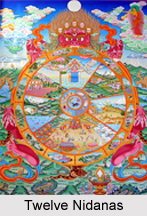
Karma is thus used as an ethical principle and a cosmological explanation for the world. Buddhists are of the faith that the actions of beings decide their own future, and due to this there are no private actions - every action has a consequence. The accent of karma in Buddhism is on attentive action, not on faulting someone else for whatever happens to oneself. There is a further distinction between worldly, wholesome karma that leads to samsaric happiness (like birth in higher realms), and path-consciousness which leads to enlightenment and (nirvana). Thus, there is samsaric good karma, which leads to temporal happiness, and then there is liberating karma - which is superlatively good, as it terminates suffering forever. Once one has achieved liberation one does not yield any further karma, and the corresponding states of mind are called in Pali as Kiriya. In Buddhism, the term karma is often used to refer only to samsaric karma, as indicated by the twelve nidanas of dependent origination.
Due to the inevitability of consequence, Karma entails the belief of Buddhist rebirth. However, karma is not the only basis of rebirth. The rebirths of eighth stage (and above) Bodhisattvas in the Mahayana Buddhism tradition refers to those liberated beings who consciously prefer to be reborn in a future life in order to help others still entrapped in samsara. However, this is not uncontrolled rebirth anymore. Buddha explains what it means to have conviction in karma: First, karma happens in reality and it is not a mere illusion. Second, one really is responsible for one`s actions. There is no external force like the stars or some good or evil being acting through oneself. When one is conscious, he or she is the one who decides what happens. Third, one`s actions are bound to bring results - one is not just writing on water and those results can be good or bad, depending on the quality of the purpose behind the act.