


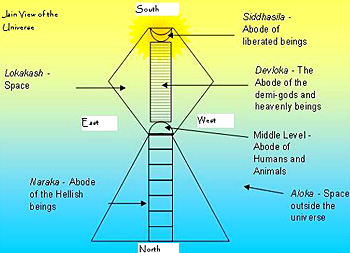
 According to Jainism, this loka or Universe is an un-created entity, existing since eternity, unchangeable in nature, beginning less and endless. Concept of Universe in Jain Philosophy is such that the Jain texts describe the shape of the Universe as similar to a man standing with legs apart and arm resting on his waist. The Universe according to Jainism is tapered at the top and broad at the middle and once again becomes broad at the bottom. According to Jainism, this loka or Universe is an un-created entity, existing since eternity, unchangeable in nature, beginning less and endless. Concept of Universe in Jain Philosophy is such that the Jain texts describe the shape of the Universe as similar to a man standing with legs apart and arm resting on his waist. The Universe according to Jainism is tapered at the top and broad at the middle and once again becomes broad at the bottom.
Jain Philosophy states that the universe has a firm, unalterable shape and a limited size. Its dimensions can be accurately measured, and the so-called "Rajju" serves as the measure. According to the view of Digambaras the universe is 14 Rajjus high and from north to south 7 Rajjus broad. The breadth from west to east is, at the lowest position, also 7 Rajjus, but it decreases gradually till it measures 1 Rajju in the height of 7 Rajjus, i.e. in the centre of the world. The breadth increases from this point and reaches on expansion of 5 Rajjus in the middle of the remaining part (i.e. At the end of the heaven Brahmaloka), and then decreases again till it is 1 Rajju at the highest position. The abode of the blessed ones who are detached from the world is above it, on the peak of the world, 1 Rajju broad, 1 Rajju long and 8 Rajjus high. The total space of the world is 343 cubic-Rajjus. The view of Swetambaras differs from the one of Digambaras to the extent that, according to them, the breadth from the north to the south does not remain always the same and the breadth from the east to the west constantly decreases and increases, but that in both cases the decrease and increase is gradual. Then the total space of the world comes to 239 cubic-Rajjus. The lowest part of the universe is occupied by the under-world in which there are hells; the centre is formed by the middle world (Madhyaloka); human beings live here. The world of the heaven is above, like storeys, and at the top finally is the world of the redeemed. The whole world is surrounded by three atmospheres; they are called dense water, dense wind and thin wind taking into consideration their density. The non-world (Aloka), i.e. the absolutely empty space is beyond them. The form of the universe is explicated by a series of similes. Thus it is said that it resembles a half drum upon which a whole drum is placed, but the drums are to be thought of as square and not round. It is said further that the individual parts correspond to spindles, dishes, etc. lying over one another. According to the form which the universe has it is believed that the lower worlds are imagined as lying in the lower extremities, the human world lying in the region of the hips and the upper body forming the heaven of gods. |
| |||



Home > Reference > Indian Philosophy > Schools of Indian Philosophy > Jain Philosophy > Jain Cosmology > Concept of Universe in Jain Philosophy
Concept of Universe in Jain Philosophy
| Concept of Universe in Jain Philosophy says that the universe is neither created nor destroyed. It may change form but a complete change does not come about in the universe. |
| ||||||||||||||||||||||||||||

